Louis and Bebe Barron in their Greenwich Village NYC recording studio, 1956 (photo: Walter Daran)
How to record long-distance audio interviews in a time of social distance and studio shutdowns.
Prepared for the podcasters at Teaching Tolerance (Southern Poverty Law Center)
In times like these, entering a professional recording studio isn’t smart or, often, possible. Rather than stop our recording schedules, let’s adapt. Let’s find options for recording guests remotely – to get us through current and future emergencies.
The solution must be easy to use and hard to mess up, for hosts and for guests. Audio won’t be studio quality but it must be good. (Each part of the production process — edit, EQ, mix, encode — loses a little more audio fidelity. So the better the quality of the original recording the better the audio left in the end product.)
My best cost/sound recommendations:
For host tracks, set up a simple home studio for each host.
Guests: It’s prohibitively complicated and error-prone to walk guests through all the software-install, record, and upload procedures. But it is feasible to mail guests a USB mic (or headset), with a prepaid return label. [Update coming: this is impractical in viral times. (Thx, Shea)] (If no external mic, ask if they have the wired Apple headphones: Its lavalier mic is better than using a computer’s, mainly due to mouth proximity.)
Video Conferencing Services
No: Except when unavoidable.
We moderns are all video-chat savvy. And video-conferencing services record (instructions for: Skype, Google Hangouts, GoToMeeting, Zoom). But their audio recordings are all low fidelity.
Zoom seems best for sound:
Records at 32kHz sample rate (AAC, mono, ~52 kbps bitrate). The others have a much lower 16KHz sample rate (AAC, mono, 64 kbps), so less frequency range and more chance of distortion and audio artifacts (weird noises).
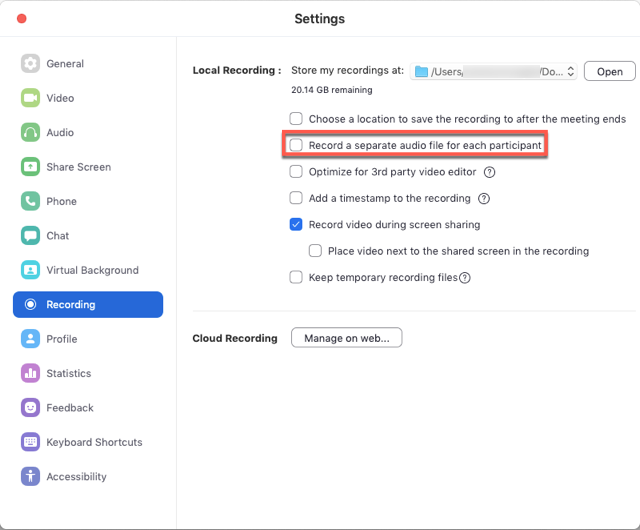
Can make separate audiofiles for each user. The others mix all the voices into one file.
Gives you an audio and video file. Most others are video-only, so you need to strip the audio out.
While down this rabbit hole I discovered:
150 milliseconds [is] the maximum latency before conversations feel unnatural. Zoom works really hard to stay under 150 milliseconds, Chief Product Officer Oded Gal said. Or maybe this: Rather than optimize the connection for all devices — which means optimizing for the worst, slowest one — Zoom tends to each individually.
—Protocol
And I know people have, use, and like Skype, but: Skype requires extensive credits during the podcast (beginning, end, and every 15 minutes). While there are ways to improve the fidelity of Skype’s audio recordings, like Call Recorder (Mac) and Evaer (Win), those third-party apps still don’t match the ease, features, and quality of…
Remote Interview Audio Recorders
Yes: Whenever possible.
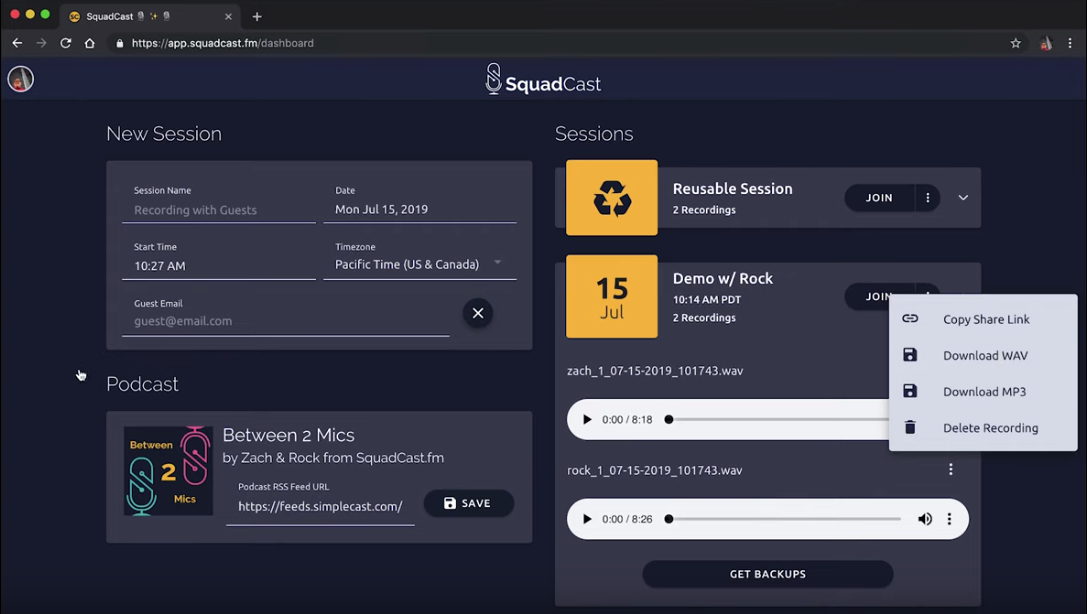
A recent crop of made-for-podcasters, remote-audio services record hosts and guests in different places. Two of the best are Zencastr and SquadCast (which I’m leaning toward). Both have inexpensive monthly subscriptions. Both work like this:
Starting the recording:
The host logs into the recording service and starts the session.
The guest goes to to a custom URL (sent by the host).
The interview and recording take place via the browser (i.e., no software installs needed).
During the recording:
Local recording: Full-fidelity uncompressed audio records onto host and guest computers (WAV, 44.1kHz, 16 bit).
Progressive upload: Hi-fi MP3s uploads to the cloud (so nothing lost if connection breaks).
Auto-backup: As the host/guest cloud MP3s upload, those files are simultaneously copied.
Auto-upload (local file): As soon as the host stops the recording, the WAVs (recorded locally onto host/guest computers) upload to the cloud.
Just like video-conferencing, the conversation happens over the internet (VoIP), which is bandwidth limited so loses audio fidelity. The recording, however, doesn’t use internet audio: It captures each participant’s computer input (the mic plugged- or built-in) then writes the recording directly onto their harddrives — no audio lost.
We’ll be testing the following two remote-interview recording services (and updating this post) soon. Both are well-liked by reviewers and work similarly, with a few differences:
SquadCast
SquadCast‘s advantage is their option to open a video screen (not recorded). Seeing each other speak improves the rhythm of a conversation.
They have a nonprofit discount, a free trial, but no free plan for subscriptions. Recordings upload to their cloud service. (They don’t specify where: Amazon, Azure, their mom’s basement?)
Their support docs have plenty of videos but lack screenshots: a faster way to convey computer info. But their FAQ, How to Be a Guest page, and how-to intro video are good.
Zencastr
Zencastr deserves cred for their COVID response, removing recording-hour limits on their free Hobbyist plan. Recordings upload to the user’s own Dropbox account.
They have no video screen option. (I’m a big fan of f2f interviewee interaction.) Of course, neither do tape syncs or two-way studio interviews.
Their support site is screenshot-less but has a slew of how-to videos and explainers.
Smartphone Syncs
No: Except when unavoidable.
Finally, lots of folk have posted lots of ways to record iPhone interviews (like Transom, StoryCorps, and Hearing Voices / Marketplace). But remote recording means transforming all our guests into capable recordists: color me skeptical.
Top image: Louis and Bebe Barron, electronic music pioneers, inventors, and composers of the Forbidden Planet film soundtrack (photo: Walter Daran).
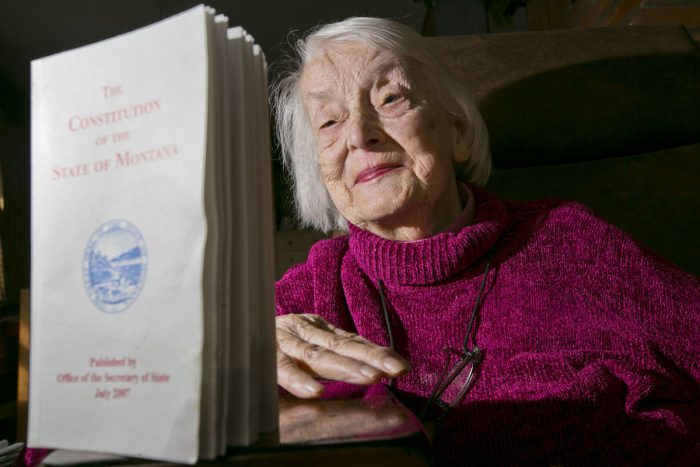
Dorothy Eck, Montana State Senator and co-author of the 1972 Montana Constitution, passed away this month.
She was one of the “Political People” who talked politics with us for this 1992 NPR All Things Considered story. Hear her @1:55 (“I don’t look at party platforms, they’re mostly baloney.”) and at @4:55 (“Who said democracy is easy?”):
The world needs more like her — Dorothy Eck (January 23, 1924 – September 23, 2017):
“The first time I heard Charley Parker I thought heard Be-Bop, like Charlie Parker with Miles Davis, it killed me. It was like: What is this chemical stuff?”
We’ve had a blast assembling the work of indies and NPR into these “sixty-minute streams of driveway moments.” We’re proud of our Peabody and other awards. We’ve loved the thousands of emails and site comments listeners have sent us. But all good things…
So, to you, our site visitors: Thanks for helping propagate outrageous radio.
“Solidod: An Apache Original” (2012 / 52:00) Larry Massett
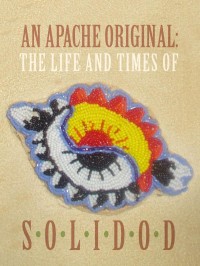
The Life and Times of Solidod, the last remaining member of her village of Mescalero Apache who lived on the edge of Death Valley. HV editor Larry Massett helped our friend Solidad publish her new e-book, An Apache Original: The Life and Times of Solidod.
Larry composed and performed the piano music in this radio hour.
Solidod is in her 80s and tells about 300 years of her life stories in the book. Here’s an excerpt from Larry’s…
Introduction
When I first met Solidod she was living alone in a tiny room in a rather depressing subsidized-income apartment complex in Florida. She herself was anything but depressing, though. A few minutes after we met she showed me the little knife she carries with her in her buckskin purse. “But Solidod,” I said, “that’s kind of a dangerous knife, isn’t it?” I said- meaning, dangerous for an 80-year woman. “Yeah, it’s sharp,” she laughed, “but it would be better if it was rusty. So the cut would get infected in case I stab somebody.”
Wow, tough lady. Tough, but also funny, curious, brimming with energy, and a world-class storyteller. As she told me about the adventures of her life I realized she’s been everywhere and done just about everything: horse-trainer, bodyguard, trans-Atlantic sailor, carpenter, gardener, artist, you name it. And she’s busy. She spends her days zipping around town selling the t-shirts she paints and the jewelry she makes, checking on old friends and chatting up new ones. Most people her age seem to be winding down; Solidod’s just getting started…
Me and my Indian, my husband
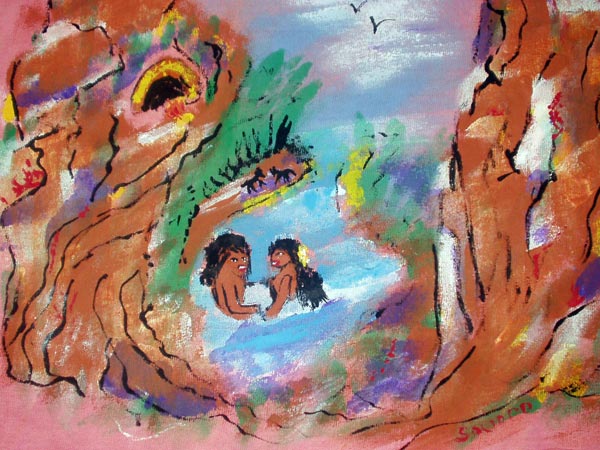
Several of Solidod’s paintings grace the book’s pages. The e-book is in Kindle format: Amazon make a free Kindle Reader for nearly every computer, tablet, smartphone, and web browser. More…
In May of 2012, Soundwalk Collective traveled into the heart of the Peruvian Amazon to document the ancient chanting rituals of the Ayahuasquero, the Master Shaman and practitioner of plant medicine. In this ritual, the shaman consumes a potent brew made from the Ayahuasca, a sacred vine of the Amazonian jungle, the “vine of the souls”. The brew induces a powerful psychedelic experience that causes visual and auditory hallucinations.
It is in this state that the Ayahuasquero conjures the “icaro” or magic song.
The icaro is more than song, it is a language through which the shaman communicates with the spirits of plants and animals of the jungle — he speaks through them and they sing through him. There are more than a thousand icaros, through which Ayahuasceros call on the spirits for healing, protection, or attack. Icaros can stun a snake, cure a bite, call the soul back to the body, make a sorcerer fall asleep. Icaros are “pure sound,” melodies abstracted so as to become intangible, to become air. In this intangible and most powerful form icaros allow shamans to swallow darts, visit distant planets, call the rainbow, and kill.
Blowing, rattling leaves and singing are synergistic modes of sound that are, at once verbal, unintelligible and abstract — elevating the song to something transcending language. This piece by Soundwalk Collective documents the ancient practice by inhabiting the Ayahuasquero’s soundscape where the icaros become a visceral, haunting, and consuming listening experience.
“Ayahuasqueros” is a radio essay by anthropologist Jeremy Narby, in collaboration with Francisco Lopez, featuring Victor Nieto and Ushamano Walter Martinez. It was ommissioned by Radio France Culture, mixed by Dug Winningham, and produced by Soundwalk Collective: an international sound-art collective, winner of several Audies for their soundwalks and a Dalton Pen award for the Ground Zero w/ Paul Auster. Since 2000 they “have been sonic nomads, embarking on journeys from the desolate land of Bessarabia to the desert of Rub al Khali. By exploring and documenting the world around them through its sounds, the Collective abstracts and re-composes narrative sound pieces through fragments of reality to form distinct audible journeys.”
From a half-hour radio play, commissioned by CBS, written by poet Kenneth Patchen and scored by Cage. Broadcast May 31, 1942 on WBBM radio station (Columbia Broadcasting System in Chicago), as part of their Columbia Workshop series. Performance by Xenia Cage, Cilia Amidon, Stuart Lloyd, Ruth Hartman, Claire Oppenheim and John Cage conducting.
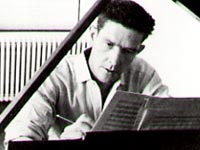
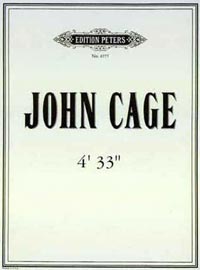
Few contemporary composers had the influence of John Cage. From experimental music to minimalism, Brian Eno to George Winston, echoes of John Cage continue to resound to this day, more than 6 decades after his “Sonatas and Interludes for Prepared Piano” were first published. John Cage was a conceptualist of sound who turned even silence into music as he did with his famous piece, 4 minutes and 33 seconds. John cage died from a stroke in August of 1992. But we hear his thoughts in sound from a 1987 interview. From the series Echoes with John Diliberto, part of their Thoughts in Sound specials.
“In A Landscape” (1994 / 2:07 excerpt) Stephen Drury
Pianist Stephen Drury performs a 1948 Cage composition; the title track of the album In a Landscape
“Cunningham Stories (At the Age of Twelve…)” (1993 / 1:44) Laurie Anderson
“Cage, Cunningham: Collaboration” (1983 / 5:27) Jay Allison
An impressionistic illustration of synchronistic artistic cooperation, in the words of Cage and choreographer Merce Cunningham. Interviews by Katie Davis, from Jay Allison’s series Living in the Arts.
The producer’s wife likes to swim at night, far out into the lake. She was taught long ago how to effortlessly, and beautifully, skim across the water. Aired originally on This American Life “Lessons“.
Mashup master GHP, aka, Mark Vidler, mixes Queen’s sports stadium classic, “We Will Rock You,” with AC/DC, Led Zeppelin, Crowded House and a bit of Beatles, Outkast, and Snoop Dogg. Download off GHP’s This Was Pop 2002-2007.
The producer spent the winter coaching a boys basketball team in her Washington, DC neighborhood. The boys’ grades aren’t good enough to play for the school, so they join a local church league. And Katie Davis starts more as counselor than coach. Originally aired on NPR. Part of the producers Neighborhood Stories series.
Spin class gets personal, with Chet Siegel as Sam, Emily Tarver as Lisa, Ed Herbstman as Kirk. Written collaboratively by The Truth, from a story by Chet Siegel. Special thanks: Peter Clowney, Kerrie Hillman, and Chris Bannon. Recorded at WNYC and on location in New York City. The Truth podcast is produced by Jonathan Mitchell (also on PRX.
Been retrospecting of late about the pool of production talent who’ve made radio waves for Hearing Voices and the Hearing Voices from NPR series — a damn impressive list of audio luminaries:
What does a city block sound like? Aaron Henkin of WYPR-Baltimore and electronic/hip hop musician Wendel Patrick hit the sidewalk, spending several months documenting the stories, voices, and people who populate the 3300 block of Greenmount Avenue, in Baltimore. We go inside the hair salon, the tattoo parlor, and the check cashing business. We talk to a street preacher and homeless street people. This is a community of different nationalities, ethnicities, and religions; in other words: an All American block.
Both producers are Baltimore-based. Aaron Henkin produced the program for the WYPR series he works on, The Signal. This HV hour also features music from co-producer Wendel Patrick’s 2011 album Forthcoming. His 2007 collection is called Sound:.
“Field recordings: Nepal” (2001 / 7:00 excerpts) quiet american
Field recordings in the Annapurna region of Nepal near Tibet, including a ceremony for the Buddha’s birthday, a few donkey trains passing in a cacophony of melodious bells; and a five-foot prayer wheel in a Buddhist gompa in Marpha.
From NPR Radio Expeditions, hidden deep in the woods of the Payette National Forest are the terraced remnants of the “Ah Toy Garden” (near the town of Warren, Idaho), now on the National Register of Historic Places. Produced by Carolyn Jensen Chadwick with sound desgin by Michael Scweppe.
When most people are headed to the beach, our producer heads for the ski slopes near his home in Utah. The goal is to find a combination of freezing and thawing in the late spring that gives the mountain snow pack the singular spring skiing experience(on PRX | on NPR).
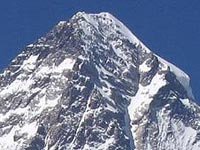
Attempting to climb the world’s most deadly and second highest demands extreme gear, training, timing, preparation, and a carefully selected team. Joe Frank eschews every bit of that: why make so easy? Excepted from Joe’s hour, Mountain Rain, available on CD and as an MP3. Music: “Buried At Sea” MC 900 Ft Jesus, One Step Ahead of the Spider.
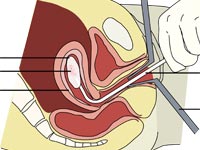
Pro-choice. Pro-life. Most people have already chosen sides in the ongoing debate, so why revisit the issue? Shades of Gray shares a range of stories told by people young and old who have been directly affected by abortion, instead of the polemics of irreconcilable extremes. It’s a carefully crafted audio mosaic and a stark portrayal of the intensely personal nature of our relationship with abortion. This is the fair and frank discussion America rarely has but desperately needs.
Winner of the 2004 Golden Reel for National Documentary. A longer version is at PRX. Produced and original music score by Jonathan Mitchell of The Truth. Co-produced and narrated by Ahri Golden of Thin Air Media.
It takes four seconds to hit the water from the Golden Gate Bridge. A year ago the producer’s friend Phil took that fatal jump. They met several years before that when Phil’s brother committed suicide (transcript).
“The Man with the White Cane” (1980 / 9:36) Josh Darsa
Herman Porter, a blind man, slipped unseen beneath a moving subway train: 90 tons of steel and electricity. (Hear Alex Chadwick’s eulogize for NPR’s pioneering producer: “Josh Darsa Obituary“.)
Writer Carmen Delzell visit her grandmother, who broke her hip — not uncommon, says the doctor, for an 89-year-old.
“The Death of Ruth Tuck” (1986 / 24:19) Scott Carrier
Scott Carrier talks to the family, the ex-husband, the mortuary, the doctors, even the grave digger, in piecing together the memory of a life. Prodcued for New American Radio. (Scott’s most recent book is Prisoner of Zion.)
“Kaddish” (1994 / 3:26)
Messages on my the producer’s mother’s tape machine, found after his father’s death; original music by Skyward. This Kaddish is a mourner’s prayer.
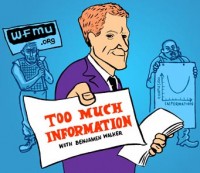
Great novels induce empathy for others’ experiences. So how is it a man now on trial for crimes against humanity is an avid fiction reader of fiction? Might he simply be reading the wrong books? We take a trip to The Hague to hand-deliver the ‘right’ books to Slobodan Milosevic. Produced with Michael Kavanagh of The Next Big Thing and HV’s Larry Massett. Ben Walker hosts WFMU’s Too Much Information, where “the sober hangover after the digital party has run out of memes, apps and schemes” (TMIplaylists / archives). He also produces The Big Ideas podcast for The Guardian.
“Keep going (feat. Tony Joe White)” (2005 / 5:03) Boozoo Bajou
“Where you boys going? The swamp… you’re not from around here, are you?” Off Dust My Broom.
Scott’s first radio piece: he and his microphone hitch from his home in Salt Lake City to the doorstep of NPR, recording the people he meets along the way (mixed by NPR’s Dawn Warneke). Scott’s most recent book is Prisoner of Zion.)
Wobbly, People Like Us and Matmos circled their wagons in the lecture hall of the San Francisco Art Institute. Having mutually agreed upon a country-and-western theme, Vicki Bennett (PLU), Jon Leidecker (Wobbly), and Drew Daniel and M. C. Schmidt (Matmos) pored over their archives of honky-tonk classics, chopping and dicing Nashville’s finest almost beyond recognition, and collectively re-stitched the mangled shreds in crazed digital quilting bee.
“It’s Gonna Rain” was composed in San Francisco in January 1965. The voice belongs to a young black Pentecostal preacher who called himself Brother Walter. I recorded him along with the pigeons and traffic one Sunday afternoon in Union Square in downtown San Francisco. Later at home I started playing with tape loops of his voice and, by accident, discovered the process of letting two identical loops go gradually out of phase with each other.
In the first part of the piece the two loops are lined up in unison, gradually move completely out of phase with each other, and then slowly move back to unison. In the second part two much longer loops gradually begin to go out of phase with each other. This two-voice relationship is then doubled to four with two voices going out of phase with the other two. Finally the process moves to eight voices and the effect is a kind of controlled chaos, which may be appropriate to the subject matter – the end of the world.
“It’s Gonna Rain” is the first piece ever to use the process of gradually shifting phase relations between two or more identical repeating patterns. The second was “Come Out.” Composed in 1966, it was originally part of a benefit presented at Town Hall in New York City for the retrial, with lawyers of their own choosing, of the six boys arrested for murder during the Harlem riots of 1964. The voice is that of Daniel Hamm, now acquitted and then 19, describing a beating he took in Harlem’s 28th precinct station. The police were about to take the boys out to be “cleaned up” and were only taking those that were visibly bleeding. Since Hamm had no actual open bleeding he proceeded to squeeze open a bruise on his leg so that he would be taken to the hospital.
“I had to like open the bruise up and let some of the bruise blood come out to show them.” More…
January 25, 2011. One year ago, a revolution began in Cairo’s Tahrir Square. For the next eighteen days, millions of Egyptians across the country would demonstrate in the streets, demanding the end of their 30-year dictatorship. They were inspired by Tunisians, whose protests, that same month, had forced out the authoritarian regime of President Zine El Abidine Ben Ali. Now it was time for Egyptian President Hosni Mubarak to go.
A few weeks after the protests, the advocacy group Human Rights Watch interviewed some of the organizers of the January uprising: union leaders, civil rights workers, young social media activists, family members of of murdered protestors, and mothers who brought their kids to Tahrir to clean after the protests.. These Human Rights Watch interviews provide a rare, eyewitness account of a revolution, told by the Egyptian people, the activists, human rights defenders, and bloggers who persevered during those eighteen days.
A retrospective of the past twelve months featuring Queen Elizabeth, Occupy Wall Street, The Arab Spring, the death of Osama Bin-Laden, the extreme weather conditions that caused nuclear accidents in Japan, flooding in the North East and fires across Texas, politicians like Rick Perry, Michelle Bachman, Ron Paul and Herman Cain making us proud, Michael Moore, Guido Sarducci, Charlie Sheen, Ali G, Newt Gingrich with music from PJ Harvey, Ry Cooder, Fleet Foxes, Bright Eyes, The Coasters, Bruce Springsteen, Gil Scott-Heron, Ashford & Simpson, John Barry, Tosca, Maceo Plex, Mickie & Sylvia, The Drifters, Amy Winehouse, Marvin Gaye & Tammi Terrell and many others.
Tributes to Steve Jobs, Jerry Leiber, Nick Ashford, Andy Rooney, Joe Frasier, Gil Scott Heron, Hubert Sumlin, Wild Man Fischer, Amy Winehouse, Clarence Clemons, Harry Morgan, Sylvia Robinson, Carl Gardner, Wildman Fischer, Phoebe Snow, Jack Lalane, and others
Some of the music in the hour:
“The Glorious Land” PJ Harvey – Let England Shake
“No Banker Left Behind” Ry Cooder – Pull Up Some dust and Sit Down
“Firewall” Bright Eyes – Firewall
“My First” Tosca – No Hassle
“Helplessness Blues” Fleet Foxes – Helplessness Blues
“Poetry Man” Phoebe Snow (Phoebe Ann Laub, July 17, 1950 – April 26, 2011) – Phoebe Snow
“Jungleland (live)” Bruce Springsteen- Born to Run
(Clarence Anicholas Clemons, Jr., January 11, 1942 – June 18, 2011)
“You Know I’m No Good (live)” Amy Winehouse (14 September 1983 – 23 July 2011)
“Love is Strange” Mickey & Sylvia (Sylvia Robinson, March 6, 1936 – September 29, 2011)
“I’m New Here” Gil Scott-Heron (April 1, 1949 – May 27, 2011) – I’m New Here
Songs by Jerry Leiber (April 25, 1933 – August 22, 2011) and Mike Stoller:
“Three Cool Cats” The Coasters
“Kansas City” Wilbert Harrison
“Smokey Joe’s Cafe” – The Robins (Coasters)
“Spanish Harlem” Ben E. King (Jerry Leiber and Phil Spector)
Songs by Nickolas Ashford (May 4, 1941 – August 22, 2011) & Valerie Simpson:
“Ain’t No Mountain High Enough” Marvin Gaye & Tammi Terrell
“Solid” Ashford & Simpson – Solid
Mixes and mashes and seasonal samples, and song stories:
“Christmas Eve In Afghanistan, Again” (2010 / 3:30) Quil Lawrence
NPR talks to troops in a U.S. military hospital at Bagram Air Base, outside of Kabul. Quil Lawrence interviewed Sergeant Wallace Trahan, Sergeant Aaron Kelly, Sergeant Zachary Scoskie, and Colonel Diane Huey. Mix: Jim Wildman. Music: W.G. Snuffy Walden “The First Noel” Windham Hill Holiday Guitar Collection.
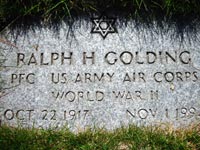
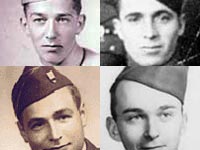
Produced for the Vermont Folklife Center: In December 1944 the Allies were closing in on Germany. Hitler had a desperate plan to save the Third Reich, a massive assault he believed would so demoralize that the Allies, they would seek a separate peace, leaving only the Russian army on the eastern front. On December 16 the Germans unleashed an offensive that would become the most brutal battle of the European war: the Battle of the Bulge. Nineteen thousand Americans were killed, about the same number were taken prisoner. We hear from four Americans soldiers about their time in — before, during and after — a German POW camp: Cliff Austin, Harrison Burney, Bill Busier, and Robert Norton.
VFC Radio published a transcript and a CD of “Prisoners of War.” Harrison Burney wrote “From The Bowels of Hell, a soldier’s memoir of World War II, 1944-1945 (143k PDF). Music: “Reitba” and “Concerto No. 3 for Double-Bass and Piano,” composed and performed by cellist Francois Rabbath; “String Quartet in C Major”, the second movement in the “Emperor” by Franz Joseph Haydn, performed by the Concord String Quartet; and “St James Infirmary” from pianist Allen Toussaint’s The Bright Mississippi.

 Jazz Bass-

 .
.





 ,” with AC/DC, Led Zeppelin, Crowded House and a bit of Beatles, Outkast, and Snoop Dogg. Download off GHP’s
  (also:
  ). Features Voices Of Shabach Community Choir Of Long Island, Stephan Stills and samples from his Buffalo Springfield song, “
 .”
.”

 .
.





 . This






 . Mix: Robin Wise of


 .
.

 ; and “St James Infirmary” from pianist Allen Toussaint’s
  .
.