From a half-hour radio play, commissioned by CBS, written by poet Kenneth Patchen and scored by Cage. Broadcast May 31, 1942 on WBBM radio station (Columbia Broadcasting System in Chicago), as part of their Columbia Workshop series. Performance by Xenia Cage, Cilia Amidon, Stuart Lloyd, Ruth Hartman, Claire Oppenheim and John Cage conducting.
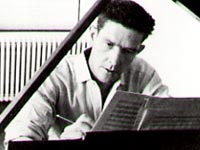
Few contemporary composers had the influence of John Cage. From experimental music to minimalism, Brian Eno to George Winston, echoes of John Cage continue to resound to this day, more than 6 decades after his “Sonatas and Interludes for Prepared Piano” were first published. John Cage was a conceptualist of sound who turned even silence into music as he did with his famous piece, 4 minutes and 33 seconds. John cage died from a stroke in August of 1992. But we hear his thoughts in sound from a 1987 interview. From the series Echoes with John Diliberto, part of their Thoughts in Sound specials.
“In A Landscape” (1994 / 2:07 excerpt) Stephen Drury
Pianist Stephen Drury performs a 1948 Cage composition; the title track of the album In a Landscape
“Cunningham Stories (At the Age of Twelve…)” (1993 / 1:44) Laurie Anderson
“Cage, Cunningham: Collaboration” (1983 / 5:27) Jay Allison
An impressionistic illustration of synchronistic artistic cooperation, in the words of Cage and choreographer Merce Cunningham. Interviews by Katie Davis, from Jay Allison’s series Living in the Arts.
The producer’s wife likes to swim at night, far out into the lake. She was taught long ago how to effortlessly, and beautifully, skim across the water. Aired originally on This American Life “Lessons“.
Mashup master GHP, aka, Mark Vidler, mixes Queen’s sports stadium classic, “We Will Rock You,” with AC/DC, Led Zeppelin, Crowded House and a bit of Beatles, Outkast, and Snoop Dogg. Download off GHP’s This Was Pop 2002-2007.
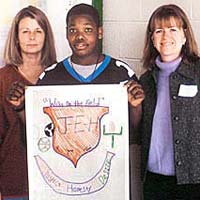
The producer spent the winter coaching a boys basketball team in her Washington, DC neighborhood. The boys’ grades aren’t good enough to play for the school, so they join a local church league. And Katie Davis starts more as counselor than coach. Originally aired on NPR. Part of the producers Neighborhood Stories series.
Spin class gets personal, with Chet Siegel as Sam, Emily Tarver as Lisa, Ed Herbstman as Kirk. Written collaboratively by The Truth, from a story by Chet Siegel. Special thanks: Peter Clowney, Kerrie Hillman, and Chris Bannon. Recorded at WNYC and on location in New York City. The Truth podcast is produced by Jonathan Mitchell (also on PRX.
From the series Neighborhood Stories– Park Life, profiling the daily life of a community’s urban oasis: “Country Bobby” Lowry is the guardian of Walter Pierce Community Park in Washington, D.C. He’s been keeping an eye on the park for almost three decades, and knows more about how it than any city official — he knows the trees, the plants and the kids. In the first of four stories about the park, we meet this transplanted farm boy who never takes shortcuts in his work. See NPR’s has great photo gallery.
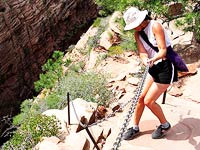
Utah’s Zion National Park draws 2.7 million visitors a year, and a major attraction for hearty hikers is a trek along the Grotto trailhead to Angel’s Landing. From the banks of the Virgin River, the yellow-and-red sandstone sides of Zion Canyon rise 2,000 feet. It feels like being inside a huge body. The canyon walls are the rib cage spread open and Angel’s Landing is like the heart.
From Neighborhood Stories– Park Life: An ode to Leah at Walter Pierce Community Park, who braids hair by the basketball court while the guys play 5 on 5.
Erica was a private investigator; now she’s a radio producer. The skills overlap: you ask questions, try to figure what happened, and make a report. (None of the interviewees were clients when she recorded them.) Produced by Larry Massett.
A good neighbor goes bad in the producer’s DC block. Dozens of rats are infesting her yard and attacking other houses. Produced for This American Life, “Neighbors,” and part of Katie’s Neighborhood Stories series. End music: Music: “Cheval Noir” Fug, Ready For Us..
“I can break the law because… I am the law.” Sleepless in Tbilisi. A twenty-four hour tour, from Turkish baths to Batumi beaches, through the country of Georgia, in Southwest Asia. High-speed sight-seeing, driven by the accidental tourguide: “a ‘detective,’ or ‘special police,’ or ‘security force.’ It’s not clear. Sometimes he even says ‘KGB,’ though that no longer exists… does it?” Music: “Dachrilis Simgera (Song for Wounded)” Tbilisi Vocal Ensemble, Georgian Folk and Sacred Songs (2002). (Annotated transcript.)
“The Story of Rose Maddox” (1996 / 13:36) Ginna Allison
The Maddox Bros. & Rose were America’s Most Colorful Hillbilly Band. In the 1930s, 40s & 50s, the four brothers and sister/singer Rose paraded thru America in their colorful Cadillacs and cowboy outfits. “Their costumes make Liberace look like a plucked chicken,” said Tennisee Ernie Ford.
Born to sharecroppers in Boaz, Alabama, they rode the rails and hitch hiked to California in 1933, where they formed the band. Their sound was both old-timey and western swing; their rhythms helped plant the roots of rockabilly. Ginna Allison’s sound-portrait features interviews with Rose Maddox, Tennesse Ernie Ford, Cliffie Stone, and her co-prodcuer on this piece, TJ Meekins of KVMR-Nevada City CA. (Images: Maddox Bros. & Rose: Myspace, Rockin’ County Style)
A preacher’s son, met in a North Carolina thrift shop, comes over the house to play guitar, and talk Jesus, G chords, and Gilligan’s Island. Carmen’s grandmother would not approve. Produced by Jay Allison for This American Life (PRX).
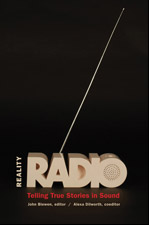
The publshers of Reality Radio have allowed to post a bit of their book. From John Biewen’s Introduction:
The goal is to bring together producers with distinctive, powerful, and richly varied approaches to their craft. Some of our essayists call themselves audio artists. They push the boundaries of journalism to the breaking point—okay, beyond the breaking point—in the service of an aesthetic vision but also in pursuit of a different (higher?) sort of truth. Others describe themselves primarily as storytellers, drawing mainly on the narrative power of the spoken word. Still others see themselves as journalists; on the surface, at least, they emphasize information over formal innovation. But the journalistic documentarians, too, give careful attention to form and, in fact, employ plenty of (conventionally sanctioned) artifice along the way.
Here’s an excerpt of the essay “Coming Home,” by Katie Davis:
A boy rumbles by on his skateboard, says his name is Julio and asks to pet the dogs. Sure. Another twelve-year-old bellows like a carnival hawker, “Hey lady, you got a tire patch?” Sure. And I give Joaquin ten dollars to run to the bike store to buy three patch kits, one for him, and the rest I’ll keep for other kids. The super from the building down the street notices the cluster of kids and lugs up two old bikes he found in the alley. And this is how, without planning, I start a recycle-a-bicycle program on my front porch. Everything takes place on my front porch for a long while.
I become known as the “bike lady,” the lady who always has granola bars and time to sit and listen. After a year, I form a youth group called the Urban Rangers and begin raising money to pay for bike parts and snacks. Two teenagers ask me start a basketball team. Sure why not? And then as I explain my philosophy to the guys, that winning is not important on this team, and everybody will get to play in every game. “No, no,” the boys interrupt and begin coaching me on how to be a coach. The dialogue is funny and that night the rusty part of my radio brain begins chanting, Good tape. Good tape.
So, I call an old friend at NPR and float the idea of writing an “essay with tape” about my team. I warn the show producer that the story will be personal, like a diary, that I break the rules of journalism in every paragraph. I write in the first person and I have not kept any objective distance from these boys. I give money to two brothers because I know they are hungry. I hire another kid’s father because they are struggling on $12,000 a year. The boys hang out at my house, they come to tell me about problems. I no longer wanted any distance between me and these neighborhood kids. NPR solves the issue of my status by calling me a commentator. My transition from reporter to commentator took four years of neighborhood porch sitting and trouble shooting and is distilled into this one word.
Recordings, remembrances, poetry, and PTSD from some of those who fought America’s longest war:
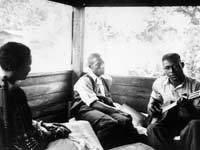
The sounds of Saigon, 1972: in combat, on the radio, in the streets, were recorded by Claude Johner for the Folkways recording Good Morning, Vietnam (liner notes 4M pdf).
Doug Peacock, former Green Beret medic, deals with the PTSD of vets, including himself (interviewed by Scott Carrier). Peacock wrote the book Walking It Off: A Veteran’s Chronicle of War And Wilderness.
Rich Kepler’s war experiences were bottled up and about to burst, until he released them in his poetry (producer: Larry Massett).
An oral history of African-American Vietnam vets, based on the book Bloods: Black Veterans of the Vietnam War: An Oral History by Wallace Terry; produced for radio by Katie Davis.
Photo by Katie Davis:
Jesse Jean with Teri and Toni.
Hearing Voices from NPR®
060 Getting Out: The Education of Jesse Jean
Host: Katie Davis of Neighborhood Stories
Airs week of: 2010-05-05 (Originally: 2009-06-03)
Getting Out: The Education of Jesse Jean (52:00 mp3):
Go to school, keep your grades up, go to college. That’s what we tell kids — over and over. What if just leaving your apartment, and walking up the block is risky? What if it feels safer to stay home, play video games, keep a low profile. When you do go out, head somewhere safe, like the teen center, the basketball court. That was the world of African American teenager, Jesse Jean.
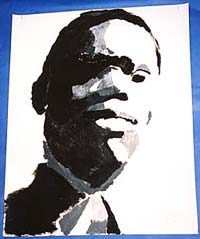
Jesse’s self-portrait
Fall 2001.)
Jesse lived a half a block from host Katie Davis in their Washington DC neighborhood. He was lucky enough to get a scholarship to a private boarding school and brave enough to take it. Katie kept in touch with Jesse, as he moved into this new world. We hear three stories covering seven years, starting in summer, 2001.
Hearing Voices from NPR®
058 Motherly Love: Moms, Young and Old
Host: Barrett Golding of Hearing Voices
Airs week of: 2011-05-04 (Originally: 2009-05-06)
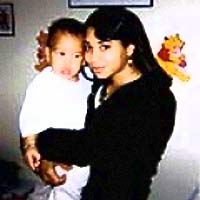
In 1996 Radio Diaries producer Joe Richman gave “Melissa Rodriguez from New Haven: Teen Mom” a microphone and tape recorder. Melissa was 18 and pregnant. Joe asked her to make an audio journal of her life, for the series Teenage Diaries.
Amy Jo, single mother of two toddlers, is “Surrounded by Lights,” by producer Erin Mishkin of Public Radio Redux and SALT Institute for Documentary Studies.
Myra Dean tells StoryCorps of the day her son was killed by a reckless driver.
Ben Adair takes his mom in search of her mom and “Family Baggage.” Ben heads American Public Media‘s Sustainability and Global Climate Change Reporting Initiative.
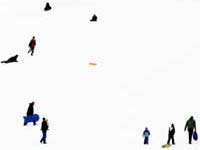
NPR Alex Chadwick invites America to share their stories of Flexible Flyers and downhill runs in a cross-USA audio Sledding Party, produced by Katie Davis. (Music: “Come to the Meadow” Roger Kellaway Cello Quartet (1974).)
Seven skiers go into the back-country, only six return; the story from the perspective of the survivors: Dave Carter, Dwight Butler, Alan Murphy, Chris Larson, and Larry Olson; in memory of Greg McIntyre.
A training day in the life of three women at the U.S. High Altitude Sports Center in Butte, Montana; with skaters Chantelle Bailey, Tara Laslo, and Mary Doctor, and trainers Michael Crowe and Susan Sandvig.
“Vatnajökull” (excerpts /2003) Chris Watson
And the sounds of Iceland’s largest glacier, captured by field-recordist Chris Watson, on his CD Weather Report(Touch Music).
Watson’s Vatnajökull sounds were also used in this Sigur Rós film, “Heima” (trailer):
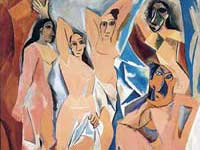
Singer Jonathan Richman puts forth the proposition that Pablo Picasso was never called an @#%hole; recorded in 1972, released on the 1976 album The Modern Lovers.
Susan enlists elementary school kids to evaluate the paintings of Pablo Picasso. Their art crit proves accurate and insightful. Co-produced by host Larry Massett.
Hearing Voices from NPR®
029 Old School: Back-to-School Special
Host: Katie Davis of Neighborhood Stories
Airs week of: 2012-06-06 (Originally: 2008-09-17)
Producer Hillary Frank gets the shy “Quiet Kids” to speak up.
Chicago Tribune columnist Mary Schmich‘s commencement speech advises “Everybody’s Free (To Wear Sunscreen),” with music from filmmaker Baz Luhrman (CD: Something For Everybody), performed by actor Lee Perry, sung by Quindon Tarver).
Host Katie Davis takes her DC summer camp into the wild woods on a “Hike to Rock Creek,” two blocks from where the kids live.
Music: Jurassic 5 “Lesson 6: The Lecture” Jurassic 5 EP, Archie Moore’s “Times Table’ With Soul and a Beat” from WFMU Blog- 365 Days Project, Lanterna “Fields” Sands, Sam Cooke “Wonderful World” Greatest Hits.
And the Tony Schwartz-inspired verite documentary of the town he lived in and loved, “New York City: 24 Hours in Public Places” (thanks to Transom.org).
Hearing Voices from NPR®:
001 Street Map— The People Next Door
Host— Katie Davis of Neighborhood Stories
Airs week of— 2009-03-04 (Originally: 2008-03-05)
Scott Carrier walks around the Salt Lake City blocks, talking to people in “The Neighborhood.”
Host Katie Davis, of Neighborhood Stories, contemplates changes at the “Corner Store” on the DC street where she grew up and still lives.
Larry Massett helps his friend bid “Goodbye, Batumi” to his hometown in the Republic of Georgia.
And a modern day Romeo and Juliet is staged, amidst a growing number of homicides, in “Oakland Scenes: Snapshots of a Community” by Youth Radio and poet Ise Lyfe.
 Hearing Voices from NPR®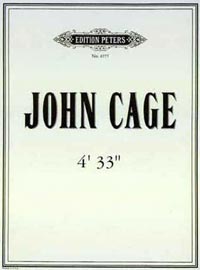


 ,” with AC/DC, Led Zeppelin, Crowded House and a bit of Beatles, Outkast, and Snoop Dogg. Download off GHP’s
  (also:
  ). Features Voices Of Shabach Community Choir Of Long Island, Stephan Stills and samples from his Buffalo Springfield song, “
 .”
.”

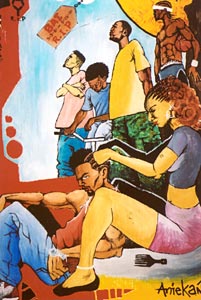 From Neighborhood Stories– Park Life: An ode to Leah at Walter Pierce Community Park, who braids hair by the basketball court while the guys play 5 on 5.



 .
.

 The publshers of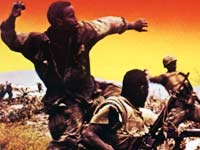



 .
.