Voices of the Dust Bowl
Migrant Workers’ Songs In California
by Charles Todd and Robert Sonkin
Play the audio in this article, selected from the collection’s 363 sound files, whereever you see the black arrow. For example, here’s Todd making a test record (1:22). And these two young sisters living in a Farm Security Administration (FSA) camp wrote and sang this “Government Camp Song” (1:38).
Todd-Sonkin 1940 Fieldnotes
Arvin Camp, Arvin California, July 28, 1940
Locale
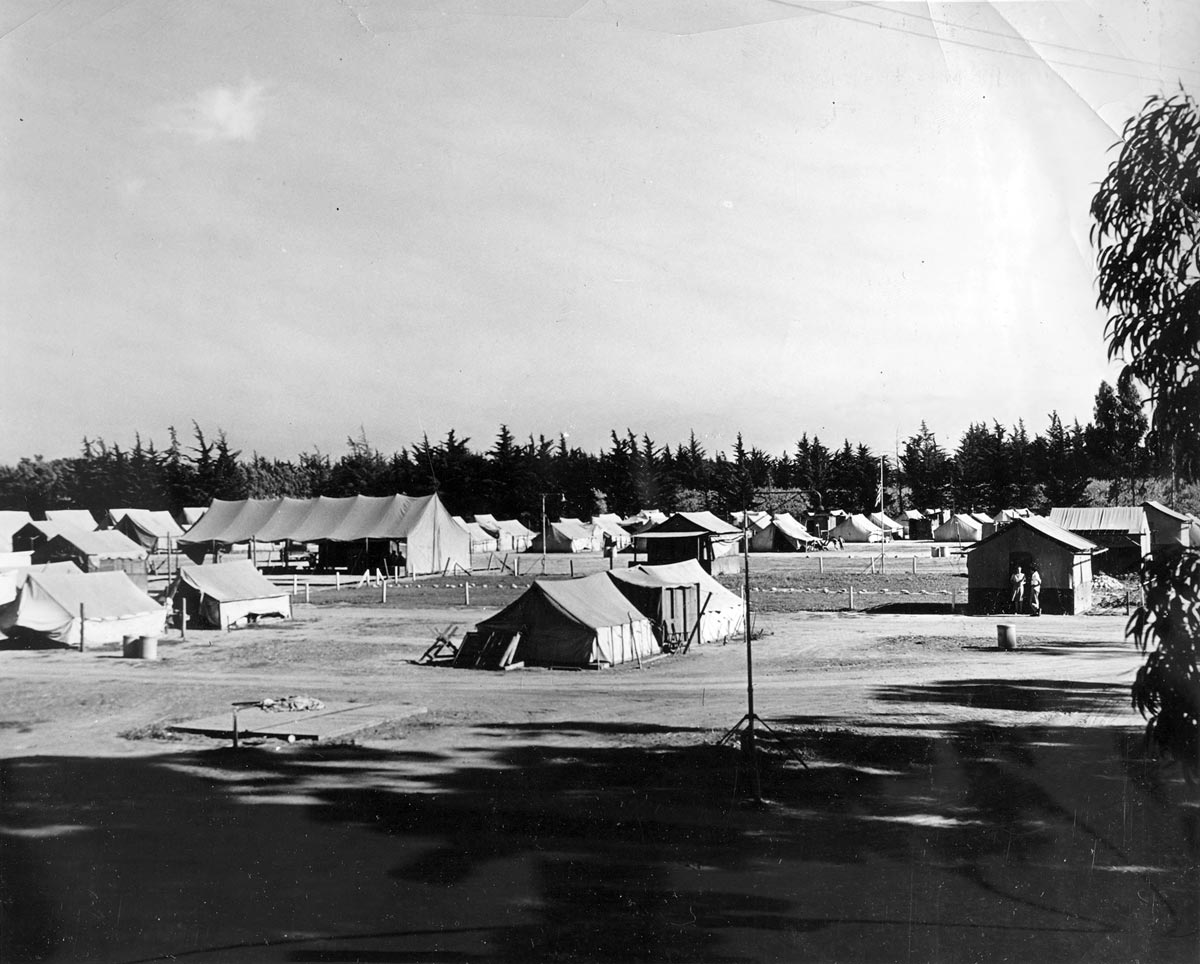
The Arvin Migratory Labor Camp was established by the Farm Security Administration in 1937 at Weedpatch California, near Arvin, in the cotton-growing region of the San Joaquin Valley. It was the first of its kind in California, and is notable as the scene of John Steinbecke’s “Grapes of Wrath”. At the time of these recordings it contained 145 families (650 persons). The camp consists of 106 metal shelters (steel, painted with an aluminum paint said to cut off the sun’s rays perceptibly), 98 tents, and 20 adobes. At the peak of the cotton picking the camp population rises to 250 families, or 1200 persons. (Average family is 4.2 persons, said to be below the average for the nation). The adobes are assigned on a selective basis. The occupant must show a record of 6 months employment in agriculture during preceding year. The adobes are permanent homestead — including an acre of ground; we saw flower gardens, etc. Rent is $8.25 per month. Rent for the shelters or tent platforms is $.25 per week. The Comm. which chooses the residents of the adobes is a camp comm. The occupants of the adobes are “permanent” — the occupants of the tents and shelters may not stay in the camp for more than a year– altho they may move back after having lived elsewhere for a while.
El Rio, California, 1941(photo: Robert Hemmig)
Diary
The machine was set up first in the dance hall, with the help of the Camp Manager, Mr. Fred Ross. A dance was scheduled for the evening (Saturday night), but no orchestra was available. The best fiddler in camp was on guard duty and refused to relinquish his post. Nor could he be persuaded to loan out his fiddle. Numerous attempts were made. but the dance was finally abandoned. The dance hall was a large rectangular building, well-lighted, and cooled by numerous fans blowing through wet burlap (“desert-cooler”). About fifty people, mostly children, gathered about the machine — all very shy, and deeply impressed by the notion that we were “guvment fellers”. First attempts to interest them in singing brought dubious results. Most of the songs were what the old folks called “late ones”. Finally, for testing, two little girls, Eileen Russell and Erlene Gibson, were persuaded to sing “On the Beach at Bali-Bali” in two part harmony, which was very well done. An attempt was made to record “The Convict and the Rose”, but neither child remembered enough of it. At this point, a man interrupted and said, “What you want is some real old Break-down stuff, ain’t it, Mister?” We assured him it was, and he promised to bring forth the next day.
Arrived in camp next morning at 9 a.m. and set up machine in sewing room. Room was attached to the Office Building, and contained flat tables and a large weaving machine (loom). Good bit of room-tone. Camp was very quiet, and a walk about the grounds showed most of the people lying about on beds, with the doors open– reading papers, playing cards etc. A few radios. Noted several guitars being tuned. Back at the Sewing room people were beginning to gather. Talked with a Mr. Russell about the migrant situation. He approved of “Grapes of Wrath”, book and movie, and said it was true — every word of it. “We didn’t expect no relief from the State — knew it was root-hog or die”. Favorite expression of Mr. Russell’s was “It kicked the dog outa me” — referring to cotton picking.
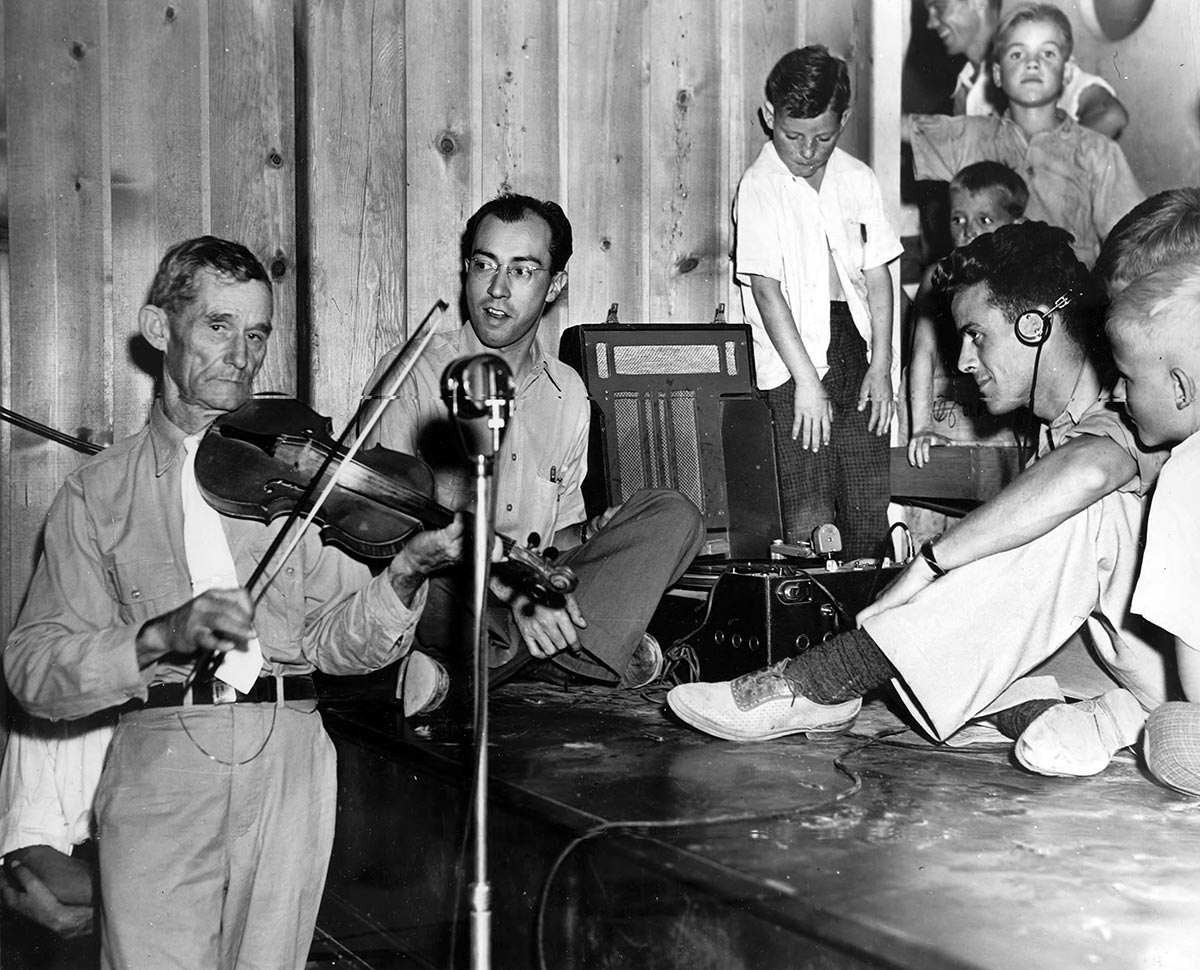
Will Neal on fiddle with recordists Todd and Sonkin, Arvin Camp, 1940 (photo: Robert Hemmig)
About 11 a.m. Nathan Judd wandered in with a guitar. Said he could sing some old ones which he learned back in Arkansas. Very hard to talk with — refused to open his mouth. About twenty years old, good looking and shy. Learned several of his songs from wax disk back in Arkansas. Called his songs mostly “sad songs and love songs”. During the first number he had to be cautioned about tapping his foot too violently. It was very difficult to get his words, and he had a tendency to shift away from the Mike [“I’m Leaving You This Lonesome Song” (1:40)]. Nathan’s wife a pretty girl, aged 17, with one child. Extremely shy. Joined him later with a nasal soprano. Both sang with poker faces and looked straight ahead of them.
At this point had a struggle with children and their mothers, who wanted records made. Every child was a singing star. Among their offerings were “Dream Boat”, “Little Sir Echo” [also: Ruth Elliot “The Old Apple Tree in the Orchard” (1:48)]. Finally, however, little Estelle Spurlock came forward, and sang a song she learned from Gussie Stone — called “Nine Little Devils” (2:47). A yodeling refrain. Estelle was 9 years old, red hair and freckles. Lots of confidence and grim determination. Looked as though she would topple over backwards, but never missed a line.
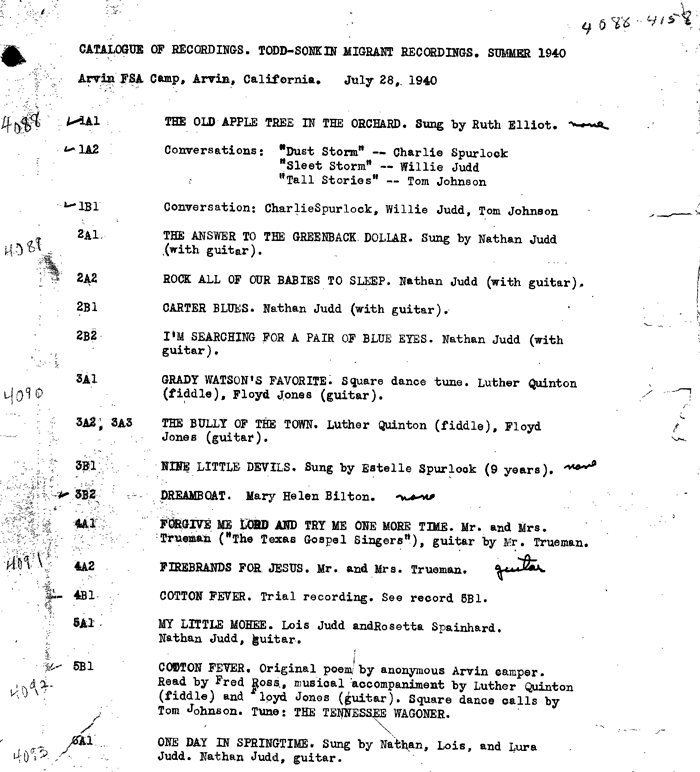
Todd/Sonkin 1940 Catalogue of Recordings
As this went on a crowd began to gather in the room, and as we had to turn the fan off for every recording it became very hot. Bob noted that “The folks never seem to wipe the sweat off their faces like we do”. True, the women didn’t seem to worry over the large beads on their foreheads.
All shyness was disappearing fast. Instruments appeared by magic, and I estimated an audience of about a hundred. Keeping children from tripping over the mike cord was a problem, and at least three babies left their wails on our records. One little boy ran into the mike, but his father caught it and the child at the same time. A public spanking ensued.
Finally Mr. Ross, Camp manager came in with a song which had been written several months ago by an anonymous camper. It had appeared in the Arvin “Tow-Sack Tattler” [“Cotton Fever” (2:43)] Ross didn’t quite know how to do the song, but said it should be spoken to a square dance tune. Quinton and Jones volunteered with “The Wagonner”. Made one recording, but Ross fell behind the music. His wife suggested another try. Song called “Cotton Fever”. This time Tom Johnson joined in with the square dance calls, Fairly good, but Ross is no Okie. The fiddles tried to slow up but got off the beat.
After this was done, Nathan Judd reappeared with his wife and asked to do five more numbers, including one he could keep (a paper disk). They both marched solemnly to the chairs and went to work. Lura, Judd’s wife said nothing, and sang as though some one had turned her on. After listening to “Maple on the Hill”, I played Frank Luther recording and we discussed the variation in tunes. The Judds were skeptical of Luther’s tune, but Rosetta Spainhard, Lura’s mother, spoke up and said that the Luther tune was the “real old ‘un”. “T’other’s a late ‘un”, she added. This interested me in Mrs. Spainhard and I asked her some questions. Finally gathered that she knew “Barbara Allen”, “Little Mohee”, and several others. Promised to sing them on Thursday, if she could find someone to play the fiddle. Had them written down somewhere. After some persuasion Mrs. Spainhard and her daughter, Lois, agreed to do “Little Mohee” (2:54). Lois, 25 yrs. old, Said her mother taught it to her about twenty yrs. ago in Kentucky.
During these recordings, noticed a young man come in with a very ancient guitar on his back, and slip unobtrusively over to the side wall. At the first lull, he came over to me and said, “I’m Homer Pierce, the singin cowboy from way down in Missouri, and I’d like to do a couple of my own tunes for you”. He was a small, fairly dirty lad with a black cap on his head pulled down over one eye. Lots of assurance. Said he worked in the cotton fields and had been in camp about two months. Claimed he had sung over the radio. Pierce turned out to be more or less the professional cowboy type, but his own songs were good [“Talkin’ Blues” (1:23)]. Pierce said he came from Southeast Missouri, but knew “Houston, Texas, a whole lot better”. Has composed some twenty songs, “made up about most anything that comes to mind”…” Used to pick up as much as five dollars a night around the beer-halls”. Learned to play a violin in two days — “pick up most any old instrument and play ‘er”. He reminded me very much of Woody Guthrie.
The final recording was made by Floyd Jones. He came up to me just as I was about to put up the machine and said he could play a harp. I jumped at that, and asked him where he kept it. “Right here”, he said, and reached in his pocket. The “harp” was a harmonica — which he played with the greatest of ease. Very serious about his talent. Previously noted as a guitar player. His piece was “She ain’t that Kind” (1:10).
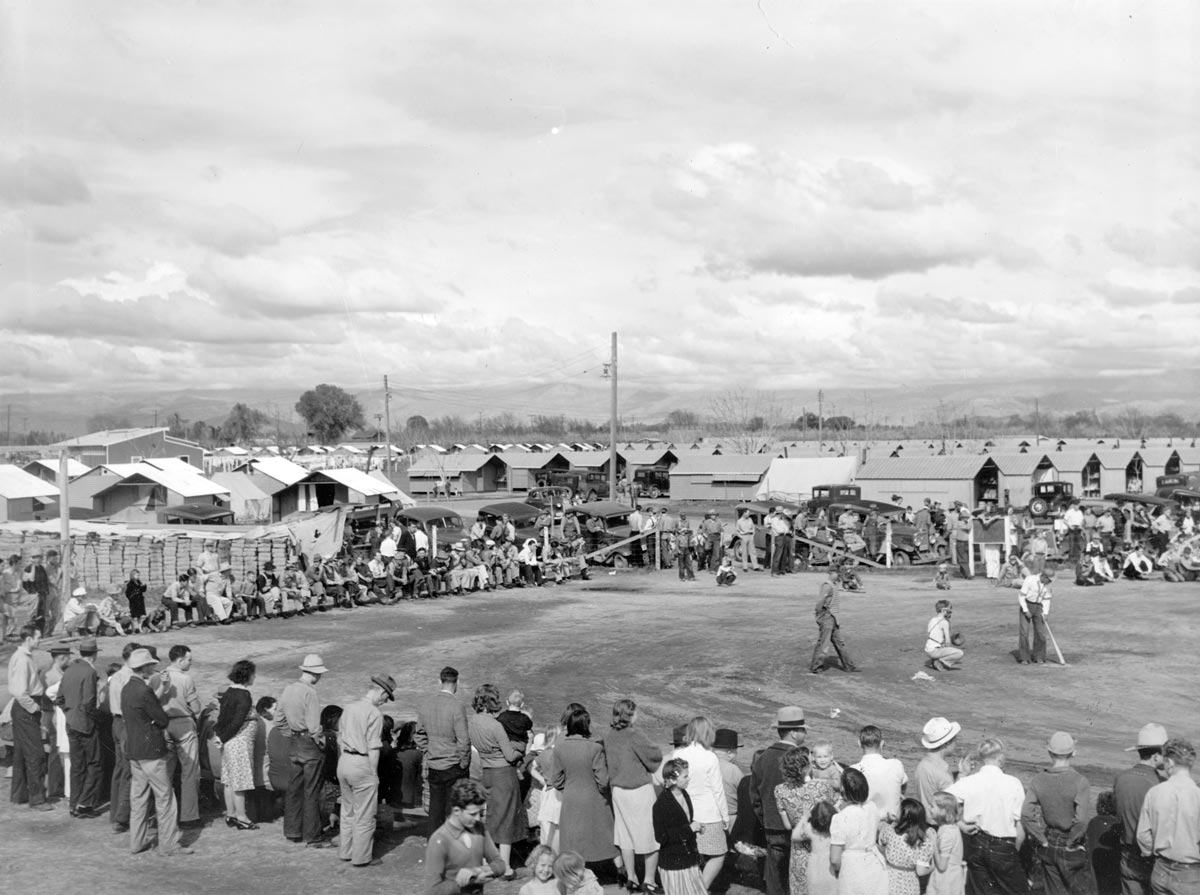
Baseball, Tulare Migrant Camp, Visalia, California, 1940 (photo: Arthur Rothstein)
Arvin FSA Camp, Arvin California, August 1, 1940
Arrived in camp at three p.m., and set up equipment in Camp library. The Librarian left us in charge of the building for the rest of the day. She is a W.P.A. librarian (“I think these camps are wonderful — never believed it before”); her hours are from two to eight each day except Sunday. The library is a branch of the Wakersfield library. “Plenty of books–now have more than we know what to do with. So long as we have enough Western stories they’re satisfied. There are just a few good readers in camp”.
Most of the men were out in the field chopping grapes but plenty of women around. First visitors were Lois Judd, her Mother, Mrs. Spainhard, and Nathan — plus the two babies. Mrs. Judd offered to read her poem “Back to Arkansas”(1:18). She had been “studying it up” for us. The poem first appeared in the Arvin Camp paper — “The Tow-Sack Tattler”. Written in Sept., 1939. Asked her if she really wanted to go back to Arkansas. Reply: “Not now — I did then….We went back”. From Imo, Ark.
Mr. Whitworth and family from Clinton, Ark. were called on in Unit 117. Mr. Whitworth had asked us to call on our last visit. Sprawled on the grass for a while with a dog, two boys, a guitar and Mr. Whitworth. A comfortable rocker outside the tent. Mrs. Whitworth stayed inside because she was “too dirty to be seen”. We talked to her through the screen. Went out and got Scarborough and began a conversation about old ballads. She remembered many of them — including “Pretty Polly”, and others. Whitworth said he had spent a lot of time and money on his own voice. A nice looking couple, with a little more refinement than some others. W. in blue trousers, and good shoes. After a long talk, they agreed to come over. Mrs. Whitworth appeared later in very clean blue sacks, with her hair well done, and looking about ten years younger than when we first saw her. Zelmer Ward came along with his guitar (Mr. W. had been coaching Zelmer for the occasion.)
The first song was “The Wildwood Flower” (2:24), with Zelmer doing a fine accompaniment. This she learned from a Carter family record. During recording the Whitworth little boy laid on the table top, running a fever. Had stepped on a bur. Sonkin baffled by words to “Wildwood Flower” — ex. “I twined with my mangles and wavy black hair”. This was probably “I toyed with my bangles and waving red hair”. This was followed by “Storms are on the Ocean”.
The next disk is a recording of an original poem [“The Job’s Just Around The Corner” (2:24)] by Mrs. [Imogene] Chapin. She came from Marshall, Arkansas, and arrived “a year this June” with seven cents. Came originally from Missouri. Wanted to be a school teacher. Had also lived in Iowa. Biography is in poem. Appeared In Sept. 29 issue 1939 of Tow-Sack Tattler. “I’m always writing some little old verses whenever we’re off on a trip or anything, an’ I Just wrote this down the last minute, an they asked me to let em print it in the Camp paper. Didn’t like Cal. when we first came, but “changed my mind a lot since first came”. “Landed here with just seven cents so we had to stay. “Cant live on scenery back in Ark.”
We still felt that something better could be done with “Cotton Fever”. Mr. Ross had confessed (not for publication) to having written it. Made one for Ross himself (1:31). Used Quinten and Jones again for music. Had musicians fade back at end of song.
Quinten and Jones did a square dance tune called “Billy in the Low Ground” (1:55). Both refused to admit that they knew any tunes — had to be pried.
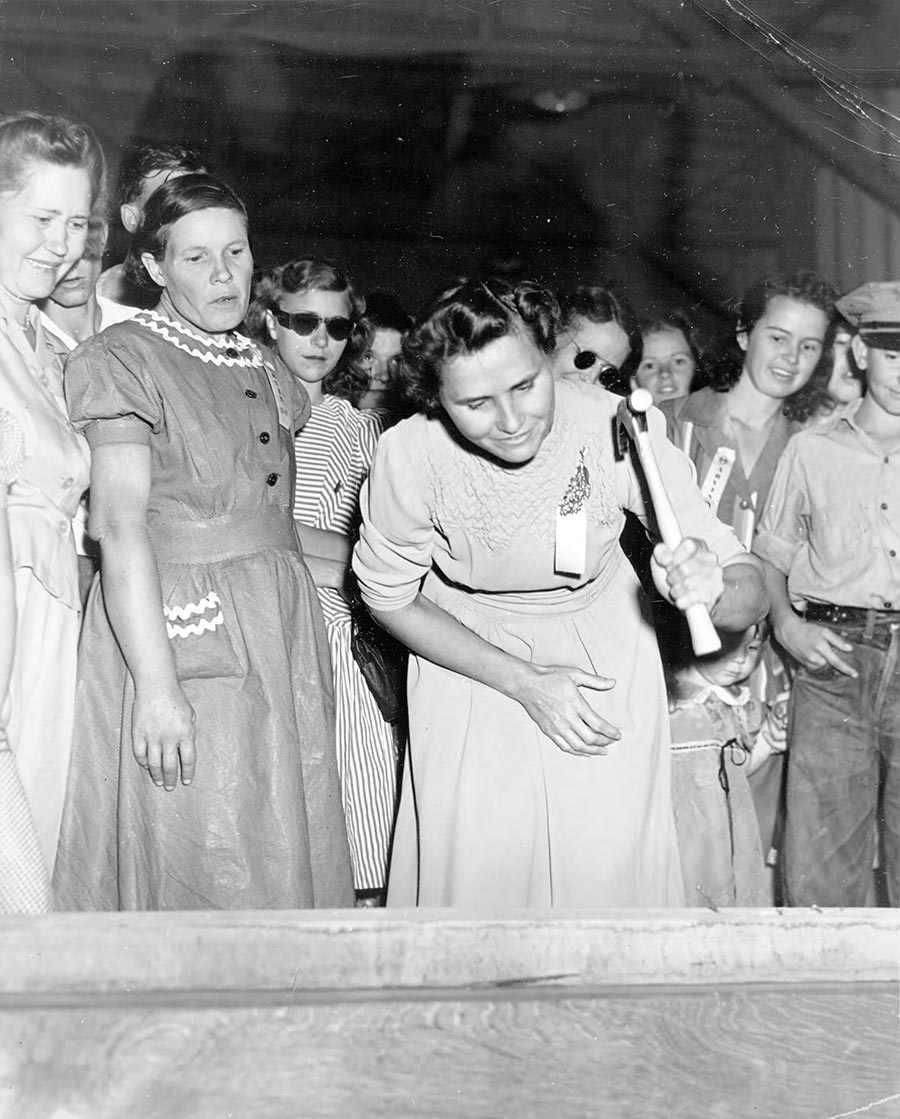
Arvin Camp, 1939 (photo: Robert Hemmig)
The next disk is a poem [“The Government Camp” (3:19)] by Mrs. [Rosetta] Spainhard about cleaning up the Camp. Appeared Oct. 28, ’39. “Lots of confusion in camp, you know, big bunch like there is here, kinda fussin around — had to clean up utility buildings and things like that.”
Drove over to Adobe 10 with machine to call on Gussie and Earl Stone. Two room house, with sleeping porch. Very clean and well furnished. Motto and poem about Mother on wall. Gussie, 18, was sitting on bed pouring over a road map. Had a difficult time talking with her. “Didn’t know any songs — hadn’t played since she got married four months ago”. Gussie belongs to Ward family. This family, Harrison, Father, Zelmer, lives near a packing plant in Lamont. Mail delivered at Camp. Whole family except Mother sings. Mother (Ma Joad type) said she had been busy working so that the others could sing.
Sussie sang “Goin Down the Road Feeling Bad” (1:11) with great spirit.
Among other things, she explained that she was used to singing with her sister, and could sing alone. She is the one who gave the Spurlock girl the “Nine Little Devils” which she had learned in Arkansas.
Incidental
Fire call in afternoon up on the ridge, sixty-five men signed up. Got 30 cents per hour. One man went who had just put in a ten hour day.
Just as we left, a little boy broke his arm by falling off a a fence. Little towhead. Ross rushed out and picked him up. Carried to a car which wouldn’t start. Mother became hysterical. Kid bit his lip and turned on her “Aw, shet up Maw…I ain’t never hurt a bit….Shet up, Maw.” From then on not a word or tear from him. Arm broken squarely at the wrist. Father finally found a car that started and took him 16 miles to Bakersfield Hospital. Same boy who had been whipped the day before by his father — after which Ross had called father to task and threatened to send him to Labor Camp at Weedpatch. “Listen Ross, this is my kid!” etc.
Shafter FSA Camp 8/3/40
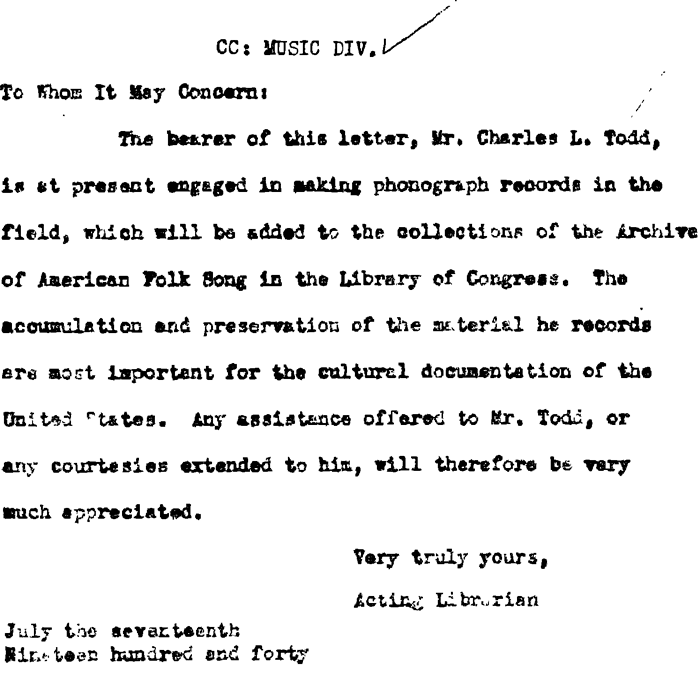
LOC letter of introduction for Charles Todd
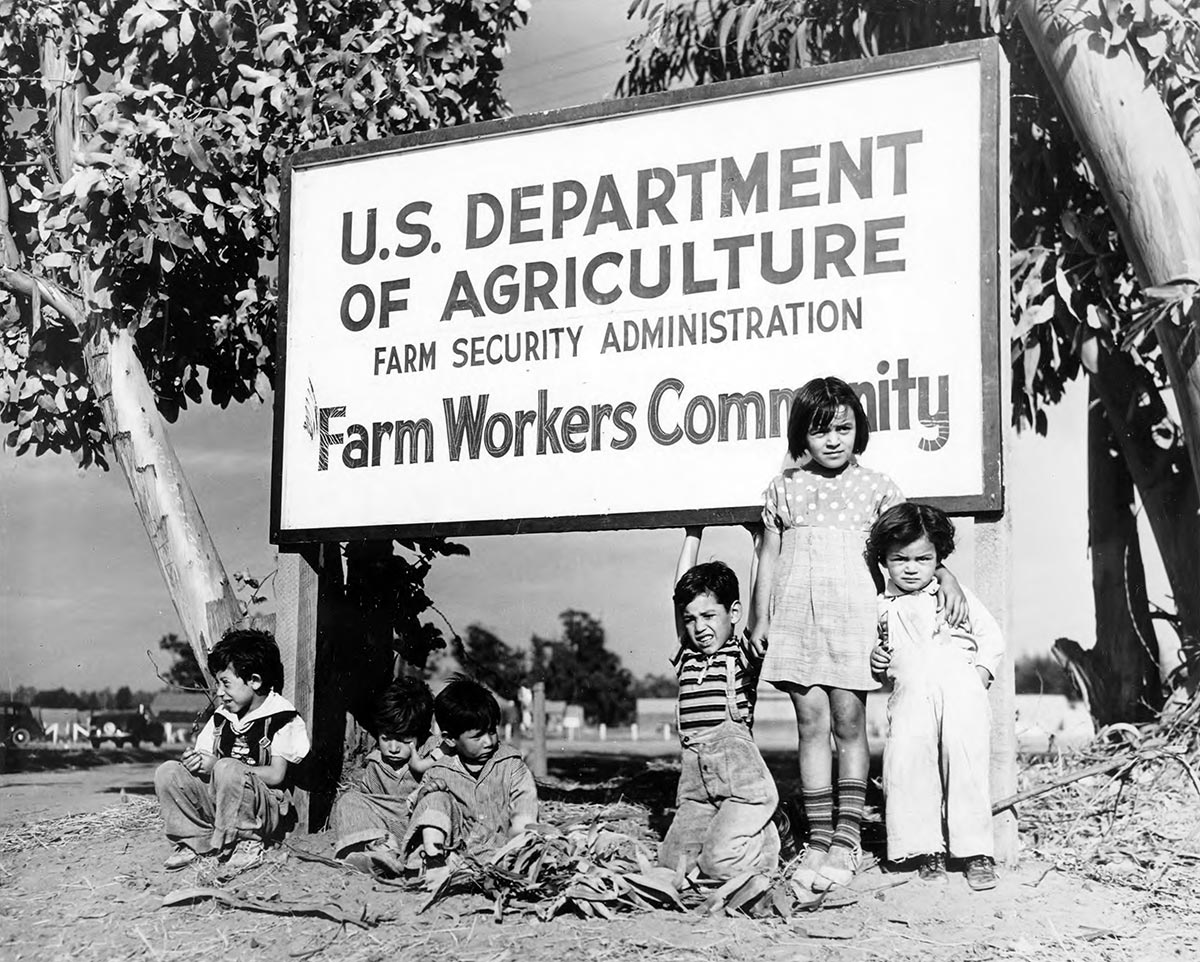
We arrived at the Shafter Farm Workers Community at 3 p.m. The clerk on duty in the office (Mr. Riedel) directed us to the Camp store to find Mr. Dewey Rogers, assistant camp manager (title?). According to the wife of the store manager, the blueprints from the FSA office were “upside down”. They indicated a slope to the roof which was obviously slanting in the wrong direction. The camp carpenter took it upon himself to change the plans.
Dewey Rogers: heavy-set, rapid speech, eager to help. Took us first, to the recreation hall where Mrs. Pond and her daughter-in-law, Vernie Westfall, were conduction a play hour for the children. Weekly and Sat., 3:30 to 4:30 (this in addition to the WPA nursery school). Children were fed 2 meals per day at nursery. Mr. Pond, nephew of Major Pond, lecture bureau, was vice-chairman of the camp council and chairman of the finance committee. Explained that the council had appropriated money to provide candy for the children at the conclusion of the play hour.
To the library where we set up our machine. Dewey Rogers brought around O. C. (“Cotton”) Davis, day guard of the camp.
Cotton Davis: 35, extroverted, full of gags and witty sayings. On being introduced said, in response to conventional “How are you?” : Here by being careful.
Played for Rogers and Davis a few of the records made at Arvin. Both especially pleased with the recording of Fred Ross, “Cotton Fever”. Rogers (reflectively), “There’s plenty of truth in that…16 bits a hundredweight…”
Shafter Camp:
Larger than Arvin but has been decreasing in population since the potato harvest. At this times 124 families, (577 persons). Capacity 240 families, 245 counting 2 “isolation”. These are distributed as follows:
* 40 labor homes * 4 metal shelters * 245 tent platforms
Population further decreased at time of our visit by absence of large numbers of men who were off fighting a forest fire “on the ridge”. We saw a large Greyhound Bus taking some of the men off. 51 had gone the day before we arrived; 60 more had been called for today.
During our visit several persons told us how unfortunate they thought it was that we had not been able to come earlier when there was more “talent” in the camp: e.g. the Luker girls, etc. We felt, however, that there was a great deal of talent in the camp: many skilled guitar-pickers, and at least a few good sources of folk-material.
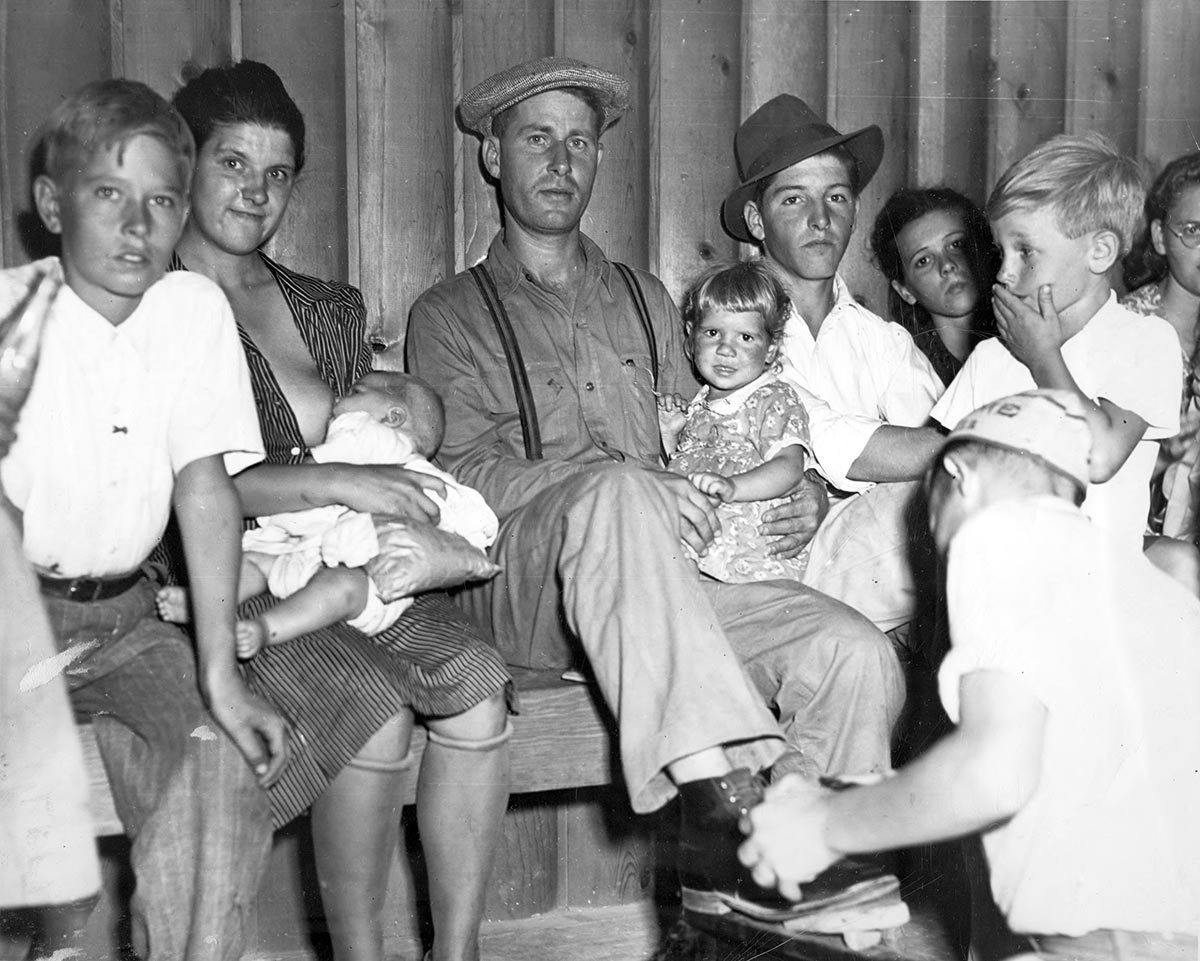
Shafter Camp, 1940 (photo: Robert Hemmig)
With Davis to look for Lloyd Stalcup, 14 year old boy who has written an original song about the migrants. Boy not at home: his mother, when Davis told her who we were and what we were interested in, asked: “Are you a striking outfit? If you are, we won’t have nothing to do with you.” She was easily placated and promised to send the boy around in the evening.
Conversation with Davis on the way back to camp (and over a bottle of beer) : indicated that the union had not been very successful in organizing in the Shafter Camp. Organizers were heels; stupid planning, etc. Still, camp has bad name with some of the growers; occasionally they refuse to hire men who live in the govt. camp.
7:30 p.m. Machine set up in the recreation hall [test (1:22)]. Started off by playing (audience 50–75) some of the songs recorded in Arvin. Explained what we were looking for. Audience gradually warned up. Two women unconcernedly nursed their babies in the front row. In effort to win audience, even conducted short community sing (Record 17 A- 1–Songs: “Playmates”). Classic performance.
LLoyd Stalcup. 14, mature face. Born Padukah, Texas. Age of 8 to Amarillo. Family to California for his brother’s health (had asthma: now completely recovered: “you’d never know he had it to look at him”). Here 2 years. Sang original song: “Cotton Picker’s Song” (1:06). Tune adopted from the theme song of the Rambling Cowboys, a radio group in Texas.
Lloyd Stalcup. A Stuttering Song (1:02). Learned it from a man in East Texas. Heard him sing it 2 or 3 times and learned it. Lloyd’s performances much appreciated by the audience. Our next performers were:
“Spanish Two-step” (0:40). Ernest Alston (15) from Russelville. Ark., here 1 mo. (before that 6 mos. in Arizona (guitar); Hardin Puice. 18, from Wagoner Co., Oklahoma, here 4 mos. (“harp”).
We had given Harding 50 cents to run into town and get himself a new harp. Harding: very gangling boy; Ernie: better-looking, looked much older than 15. Ernie during all of our visit followed us around with his guitar offering to sing for us and trying to think of songs he could do for us [“Careless Love” (1:03)].
By this time Margaret Treat, age 11, felt sufficiently bold to sing us the song she had promised. With the ubiquitous Ernie Alston playing the guitar accompaniment she sang “The Great Speckled Bird” [recording lost). Margaret, like many of the other migrants, keeps a “ballet book”. In this she records the “ballets” (i.e., the words) of songs she is learning. We borrowed Margaret’s ballet book later in the evening, and the following day copied out a text of the Wabash Cannonball (Vernie Westfall, Allston (1:52)] which differs interestingly from that sung by the Mangrum Trio in Arvin. We also copied out the titles of the songs in her book. See this list.
Margaret Treat's Ballad Book.
Shafter FSA CAMP

List of titles

*	1--CAN THE CIRCLE BE UNBROKEN
*	2--MAY I SLEEP IN YOU BARN
*	3--BLUE EYES
*	4--MY HOME IN MONTANA
*	5--THE GREAT SPECKLED BIRD
*	6--PENNIES FROM HEAVEN
*	7--RINFRO VALLEY
*	8--MAPLE ON THE HILL
*	9--WABASH CANNON BALL
*	10--OLD FAITHFUL
*	11--SOUTH OF THE BORDER
*	12--ROLL OUT THE BARREL
*	13--NOBODYS DARLIN BUT MINE
*	14--EL RANCHO GRANDE
*	15--TWENTY ONE YEARS
*	16--ALL AROUND THE WATER TANK
*	17--BROTHER JACK
*	18--COWBOY JACK
*	19--THERE'S MORE PRETTY GIRLS THAN ONE
*	20--IT MAKES NO DIFFERENCE NOW
*	21--OUT ON THE TEXAS PLAINS
*	22--I'M JUST HERE TO GET MY BABY OUT OF JAIL
*	23--A LETTER FROM HOME SWEET HOME
*	24--DADDY AND HOME
*	25--WHEN ITS LAMP LIGHTING TIME IN THE VALLEY
*	26--I WONDER IF YOU FEEL THE WAY I DO.
*	27--I WANT TO BE A COWBOY'S SWEETHEART
Ernie Alston’s parents are dead. He is here with his brother. He has been playing the guitar for about six months. He picked up his guitar for three dollars. He is from Russellville, Ark.
Other songs recorded that evening were by Mrs. Vernie Westfall [“Old Gray Beard A-Shaking” (1:57)], from Muskogee, Oklahoma, wife of L. D. Westfall (son of Mrs. Pond).
The Westfalls and the Ponds are from Muskogee, Oklahoma. They represent, it seemed to us, a kind of more or less self-chosen intellectual aristocracy in the camp. Mr. Pond, as we were to discover at the council meeting later, has a fine working knowledge of parliamentary law, and a certain natural dignity which enabled him to conduct the meeting of the council with great skill. Mrs. Pond, a rather nervous exophthalmic-goiter type, is very enthusiastic about the work she (and her rather reluctant daughter-in-law?) have recently started with the children of the camp. There is, however, a certain self-consciousness about the way she speaks of wanting to help the “poor, underprivileged kiddies”. We will always remember the pathetically grotesque figure she made that afternoon in the play group her arms stretched high above her head, as she tried to get the attention of the children for the game “New Orleans”. Mr. Westfall, editor of the camp paper (Covered Wagon News) — for which Job he gets $5 a week — has a penchant for drawings of nude and semi-nude females which he stencils on the pages of the newspaper and which show thru the mimeographed text like a watermark. The following afternoon, when we visited the newspaper office, and Mr. Westfall was going thru some back numbers of the papers, a photograph fell out which he palmed quickly. Of these pictures more later (see report of the council meeting). Summing up the Ponds-Westfalls: they seem to represent the more self-consciouslys self-respecting element of the community. Thru their positions on the council, newspaper, etc., they are a group which is definitely “in”, (Both Mrs. Pond and Mrs. Westfall smoke, rolling their own). They smoke quite openly.
As the evening ended and the group broke up, and we were standing around talking, two young girls stopped to tell us about their mother and the many lovely songs she knew. The mother, Mrs. Mary Sullivan, was very modest but promised to sing for us the next day.

Covered Wagon News, Shafter Farm Worker Community, December 1940
Shafter FSA Camp 8/4/40
Back in the ironing room. Went down to Mrs. Sullivan’s tent to call for her. Found her daughters busy arranging her hair.
Mrs. Mary Sullivan comes from near Warm Springs, Texas. She has been in California for three years. She is one of the recreation leaders in the camp (i.e., WPA), in change of arts and crafts. Last year she went up to Bakersfield once a week to attend classes in arts and crafts. Mrs. Sullivan is one of the few Okie women we saw who look younger than they really are. She is the mother of a very large family, but her figure is neat, and has generally youthful appearance.
LLOYD BATEMAN (5:05). Sung by Mrs. Mary Sullivan. Mrs. S. sings this song with great emotion. It was this song that her daughters had told us about, and had indicated they considered one of her best songs. At several points in the song she almost broke down, sniffing audibly. Her daughters giggled at this, but not, we felt, irreverently; rather thru a kind of embarrassment (cf. the youngster with the broken arm at Arvin: it was the idea of his mother making a kind of spectacle of herself that troubled him). The other members of the audience standing around as we worked were deeply moved by the song.
Conclusion of LLOYD BATEMAN (2:41). Mrs. Sullivan thinks of her songs as complete things, and she was disappointed that there had not been room on one side of the record to catch the whole song. In general we found that these folk-singers like to finish a song once they have started it. Mrs. Sullivan’s style of singing we thought of as singularly pure: she uses occasionally little slides and breaks in the voice which add to the pathos of the song. These breaks are not to be thought of as occurring haphazardly, but are to be considered part of the tune; for, whenever Mrs. S. repeats these tunes, or sings the same stanzas again, the breaks occur in almost exactly the same places. All of Mrs. Sullivan’s songs were learned when she was quite small.
Merle Lovell. Handsome, middle twenties; rather hysterical laugh. As soon as he came itno the room he squatted down with his back to the wall and, a borrowed guitar in his hands, began improvising. Squatted down beside him: We have found that squatting with these people helps to build up their trust in us! Lovell was in a bad way, still half asleep he informed us after a big night (Sat.). (Comes from East Oklahoma)
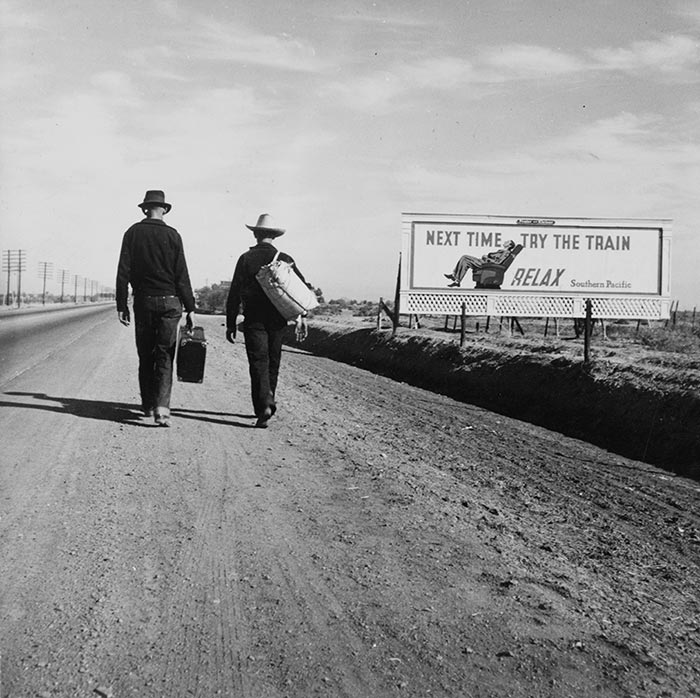
Toward Los Angeles, California, 1937 (photo: Dorothea Lange)
Merle Lovell: I RODE SOUTHERN? I RODE L. M. (3:04) Learned this song from a record of Homer Cowhand (?).
SHORTIE ALLEN. — (First name: Vernon?) Small man, (Hope, Ark…Left in 1934 — back twice for visits) indeterminate age, small, red-lidded eyes almost always half shut, upper front teeth capped with a kind of tarnished silver metal. One of the camp characters. Known as a teller of tall tales. “He’s told those stories so long, he’s come to believe them himself.” Sometimes gets mad if people don’t believe him, according to the others. This record is a medley of three of the stories he is proudest of. At least the first of these (rattlesnake-whiskey — frog story) we recognized as not being original. (Learned from the radio?!) But Shortie always told them with gusto, and they were thoroughly appreciated by the men around. Shortie apparently is content to play the clown for the others. Nothing like that about his wife, who at the council meeting went to bat for her unit’s washing machine with so much energy and intelligence [“Shady Grove” (2:34)].
SQUARE DANCE [“Sally Goodin” (3:51)]. Caller, Walker King; Fiddle, Willard Brewer; guitar, Red Harmon.
Dance with calls (“Figure 8”). Some of the calls:
Round up 8 and go circle south
Everybody wind
Rt. left the old left hand
Go rt. away around.

Watch you partner watch her close
When you meet her go double(dosie?) dos.
Once and a half and the other half too…
Original composition “ALL ABOUT THE CAMP” (2:31) by Mrs. Pond, read by her son L. D. Westfall. Text had appeared in the camp paper. Mrs. Pond didn’t want to read it, because it was supposed to be spoken by a man. Got her son to do it, who did not do an especially good job of it. As he read, Mrs. Pond, who apparently knows her compositions by heart moved her lips, saying the words to herself. She gave him instructions about reading it, too: the mosquitoes are supposed to say “cuzzen”, with a very buzzing onomotopoetic effect. Got this recording after the council meeting had adjourned
Shorty Allen with a song he had studied up for us: MADAM I HAVE A VERY FINE FARM (1:44).
In the Davis house. Metal shelter #14, Present: Mr.and Mrs. Davis, Mr. and Mrs. Sullivan, Mrs. Robertson, etc., etc. About a dozen children. Many outside.
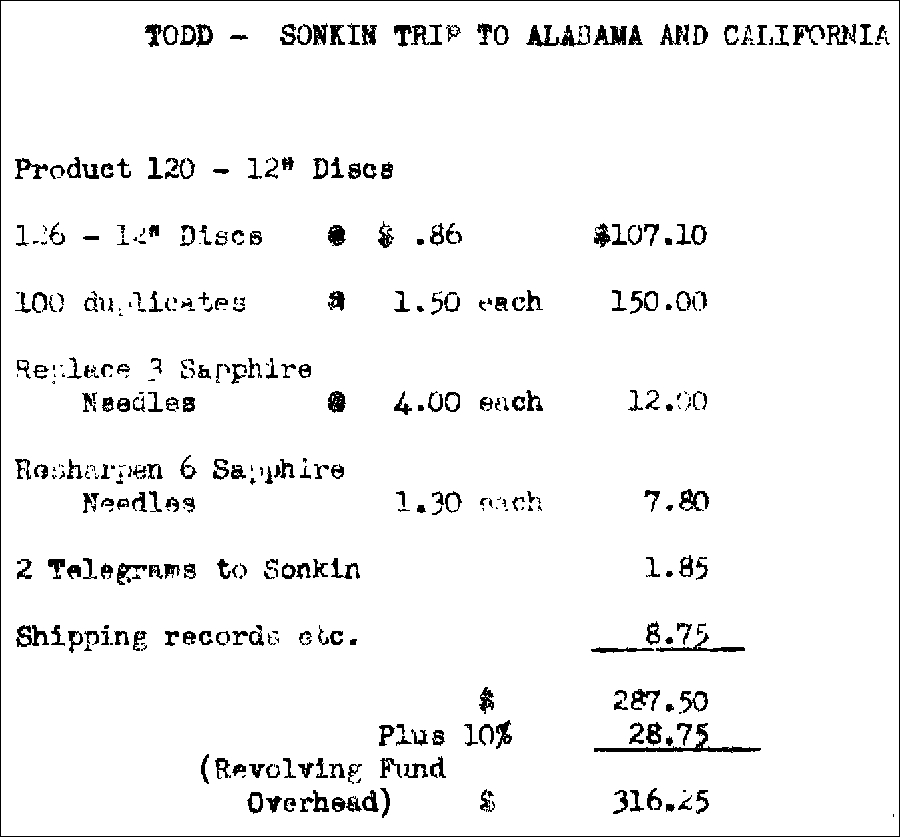
Todd/Sonkin recording expenses
A TRAVELER’S LINE (1:55 ). An original song about the camp sung by Mrs. Mary Sullivan. (From near Warm Springs, Texas; here 3 years). Fluctuations in volume may appear a/c her rocking back and forth in chair. Freight train appears at end of record. Had no title, but after thinking, Mrs, S. wrote out title above.
Conversation in O.C. Davis’ shelter:
…Chitterlin’s meat after the grease is rendered out.
…I beg your pardon. That ain’t right. Chitterlin’ is a hog or beef’s entrail.
…That’s what it is.
This leads into Merle Lovell’s songs: DISAPPOINTED IN LOVE — followed by WHEN IT’S CHITTERLIN’-COOKIN’ TIME IN CHEATHAM COUNTY (2:38).
Text, photos and sound courtesy the American Folklife Center “Voices from the Dust Bowl” exhibit, Library of Congress. The Hearing Voices series broadcast our radio doc on this Dust Bowl archive, narrated by LOC recordist Charles Todd, on the Working Class (HV098) episode.
Coming: 8/5/40. Shafter. In Arts and Crafts Shed…