Splendid with Sound: The audio world lost a great producer today, Carolyn Jensen Chadwick. With her husband Alex she co-founded NPR’s Radio Expeditions (article in Current) and produced the Interviews 50 Cents films.
Carolyn was Maya Lin’s sound consultant for “What is Missing?” She produced scores of sound-drenched, audio-intense stories for NPR — we’ve run several, with more coming.
We hope you’ll spend an hour soaking in her sonics below. Hubby Alex once described a jungle as “splendid with sound.” That phrase also does justice to CJC’s enveloping, enrapturing, sometimes ecstatic, and always engaging work.
Master-engineer Skip Pizzi (NPR, Microsoft) would play this first piece at workshops to illustrate how a simple story can be superb, when elegantly enhanced with stereo sound. David Molpus narrates a portrait of “Equestrian Olympian: Bruce Davidson” (1984 / Carolyn Jenson Chadwick, producer / 12:39 mp3):
Radio Expeditions often recorded those who recorded sound, such as Rex Cocroft on “A Journey to the Edge of the Amazon” (2006 / Carolyn Jenson Chadwick, producer / 8:54 mp3):
Among the natural sounds CJC captured were those of human nature, as when her husband Alex pitted wits with the regulars at a small-town casino, playing “Poker at the Ox” (Carolyn Jenson Chadwick, producer; Michael Schweppe, engineer / 9:55 mp3):
And in the mountains of Payette National Forest, it’s all guns, guitars, guts, and wild game, inside an “Idaho Hunting Camp” (Carolyn Jenson Chadwick, producer; Michael Schweppe, engineer / 12:57 mp3):
[Carmen Delzell lives in Mexico, travels to India, and does occasional audio essays for us. Here’s another post in her: Bag Lady’s Guide to What’s Left of the Planet…]
This time alone living in the luxury of Martha’s house has helped me relax enough to see myself and my circumstances a little more clearly.
I’m sick of Mexico. Sick of living in fear, of poverty, of the (mostly) assholes I know there and most of all sick of loneliness.
So tonight I’ve decided to head out into the night with my digital recorder and start doing a story on loneliness. You know, loneliness is probably the hardest thing to admit and for sure the hardest thing to bear.
I was inspired last weekend by a singer songwriter named Steve, who is sadly, dead.
#1 Bar Noise at a place called Buttons.
So here I am again alone in a bar waiting for this Dave Millsap to come on stage and sing the songs of Steve Bruton whose life was loosely depicted in Crazy Heart, the movie with Jeff Bridges.
I actually cried when I saw his beat up old truck drive down one of these breath-taking New Mexico highways because God Damn It that’s me driving up from the Matehuala Desert towards Saltillo, Coahuila in my beat-up Jeep and whatever it is that’s sent me down those lonely Mexican and New Mexican roads, I’m pretty sure it has something to do with movies like this.
The difference is that I’m a woman and don’t play the guitar or paint or anything except live and write about being alienated and sad and, yes, lonely. More…
[Carmen Delzell lives in Mexico, travels to India, and does occasional audio essays for us. Here’s another post in her: Bag Lady’s Guide to What’s Left of the Planet…]
Just imagine, if you can being an old (and you know I don’t feel all that old) woman with less than a hundred dollars to her name driving north on Hwy 57 between San Luis Potosi and Matehuala as the sun goes down.
A motel costs 400 pesos. So does a tank of gas.
Children stand by the side of the road holding out live rattle snakes for sale or a wild eagle dangled by its feet.
It’s getting dark.
The empty light comes on the dash board. There are no gas stations anywhere.
Food is out of the question till you get to the border; and when you do get there it’ll be another six hours to your friend’s house where you can sleep for a couple of nights.
[Carmen Delzell lives in Mexico, travels to India, and does occasional audio essays for us. Here’s another post in her: Bag Lady’s Guide to What’s Left of the Planet…]
By Carmen Delzell (Written in 1988 just before I became homeless.)
I never intended to live the way I have.
I thought—in that hazy hopeful time right after graduation and before my foolish marriage that I could be a bohemian, a colorful avant-garde part of the late 1960s and then (I’m not sure when I thought it would actually be) I expected to have a house, go to graduate school and eventually teach at some small liberal arts college somewhere.
I guess I got a lot of these notions from biographies and magazine articles that fell into my hands from my mother’s casual (and probably mundane) choice of reading material.
She herself had fancied a similar life and she too found the shock of turning middle aged without it too much to bear.
Reprinted by permission from the (private) AIRdaily:
Today is the 39th Anniversary of the first All Things Considered. The first program included a documentary of the largest anti-war demonstration in history (wikipedia). The demonstrators filled the roads, blocked the bridges and stalled the morning commuter traffic, all in an effort to shut down the government. The demonstrators were met with 10,000 federal troops, 5,000 D.C. police and 2,000 National Guard. By the end of the day, over 6,000 had been arrested, the largest mass arrest in U.S. history.
Reporters fanned out, from the Pentagon to the Mall, recording multiple perspectives of the events as they happened. I directed the program that first day, and we hustled to edit the multitude of voices into a cohesive documentary for the 5:00 ET start time.
What followed was an extraordinary 24-minute, sound portrait of the events as they happened, with the voices of protesters, police and office workers above the sirens and chopping of helicopters. Yes, there were flaws, and yet it stands as probably the best sound record of that historic day.
It also was a strong statement of the intention of NPR to get out of the studio, to use sound to effectively tell stories.
—Bill Siemering
Bill Siemering is Prez of Developing Radio Partners, NPR’s first Program Director, and author of their original 1971 mission statement National Public Radio: Purposes. You can hear that seminal DC Demonstrations report at NPR and in our HV hour of Protest. The piece still stands as both a valuable historical document and an example of what radio news can be.
“Today in the nation’s capital, it is a crime to be young and have long hair…”
—Jeff Kamen, NPR Reporter
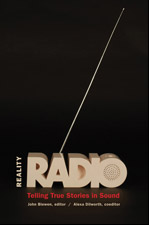
The publshers of Reality Radio have allowed to post a bit of their book. From John Biewen’s Introduction:
The goal is to bring together producers with distinctive, powerful, and richly varied approaches to their craft. Some of our essayists call themselves audio artists. They push the boundaries of journalism to the breaking point—okay, beyond the breaking point—in the service of an aesthetic vision but also in pursuit of a different (higher?) sort of truth. Others describe themselves primarily as storytellers, drawing mainly on the narrative power of the spoken word. Still others see themselves as journalists; on the surface, at least, they emphasize information over formal innovation. But the journalistic documentarians, too, give careful attention to form and, in fact, employ plenty of (conventionally sanctioned) artifice along the way.
Here’s an excerpt of the essay “Coming Home,” by Katie Davis:
A boy rumbles by on his skateboard, says his name is Julio and asks to pet the dogs. Sure. Another twelve-year-old bellows like a carnival hawker, “Hey lady, you got a tire patch?” Sure. And I give Joaquin ten dollars to run to the bike store to buy three patch kits, one for him, and the rest I’ll keep for other kids. The super from the building down the street notices the cluster of kids and lugs up two old bikes he found in the alley. And this is how, without planning, I start a recycle-a-bicycle program on my front porch. Everything takes place on my front porch for a long while.
I become known as the “bike lady,” the lady who always has granola bars and time to sit and listen. After a year, I form a youth group called the Urban Rangers and begin raising money to pay for bike parts and snacks. Two teenagers ask me start a basketball team. Sure why not? And then as I explain my philosophy to the guys, that winning is not important on this team, and everybody will get to play in every game. “No, no,” the boys interrupt and begin coaching me on how to be a coach. The dialogue is funny and that night the rusty part of my radio brain begins chanting, Good tape. Good tape.
So, I call an old friend at NPR and float the idea of writing an “essay with tape” about my team. I warn the show producer that the story will be personal, like a diary, that I break the rules of journalism in every paragraph. I write in the first person and I have not kept any objective distance from these boys. I give money to two brothers because I know they are hungry. I hire another kid’s father because they are struggling on $12,000 a year. The boys hang out at my house, they come to tell me about problems. I no longer wanted any distance between me and these neighborhood kids. NPR solves the issue of my status by calling me a commentator. My transition from reporter to commentator took four years of neighborhood porch sitting and trouble shooting and is distilled into this one word.
Something beautiful, haunting and appropriate about Jack Warga’s photo exhibit “Leaving Iraq:”
Jake was embedded with the 3rd Infantry Division, US Army. He snapped several dozen back-of-head portraits before he left. More Iraq images and audio in Jake’s Iraq Xmas 2009HV posts.
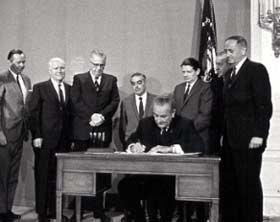
President Johnson signs the Public Broadcasting Act, November 7, 1967
The Public Broadcasting Act of 1967 established the Corporation for Public Broadcasting. “Independent producers” and “independent production” are mentioned sixteen times, including, “a substantial amount shall be distributed to independent producers and production entities…”
Some of my other favorite phrases:
The Congress hereby finds and declares that —
It is in the public interest to encourage the growth and development of public radio and television broadcasting, including the use of such media for instructional, educational, and cultural purposes;
Expansion and development of public telecommunications and of diversity of its programming depend on freedom, imagination, and initiative on both local and national levels;
It is in the public interest to encourage the development of programming that involves creative risks and that addresses the needs of unserved and underserved audiences, particularly children and minorities;
The Corporation is authorized to —
Facilitate the full development of public telecommunications in which programs of high quality, diversity, creativity, excellence, and innovation.
—Public Broadcasting Act of 1967, as amended
I read these things so you don’t have to: a 30-page essay, “IP Radio – A vision of radio in the Internet age” (Jan09 pdf), by Pierre Bellanger, CEO of Skyrock, the French radio & popular social net. Within are history and prognostications on all things digi-radio-future, but few new perspectives (“Radio, like the written press, the music industry and television, is changing”, etc.).
Did find a few entertaining morsels, like this (pg11) on the singularity and un-CG-ability of the human voice:
Just as a penguin can recognise another among thousands, since time immemorial we have been able to discern a wealth of incredible nuances and emotions in the human voice. We owe our survival to our brain’s ability to decipher the details of the voice, further heightening the effect of visual absence.
Pixar’s digital masterpieces such as Toy Story or Ratatouille reproduce the most complex visual experiences like wet fur or the shine of bodywork with a computer, while the characters express their emotions as well as human actors. Despite these wonders, for the voices the studio uses actors, such as Tom Hanks or Paul Newman. A voice is more complex than an image.
And this historical radio data (pg19) — unsourced, so can’t vouch for validity:
Radio experienced an auspicious period in the United States between 1980 and 2000. In 1995 radio represented a little over 10% of media advertising investments, or $12 billion. Prosperous radio stations generated results equivalent to 30% of their turnover. In 1995 regulations on ownership of several radio stations in the same market were relaxed. This 20 allowed the Clear Channel group to carry out a number of acquisitions; today, it owns about 900 stations with combined revenue of $3.5 billion in 2005.
The Clear Channel policy targeted profitability by standardising and homogenising programmes. Audiences considered risky and insolvent, such as adolescents, were abandoned. Further, morning shows, already attacked by influential puritanical groups and repeated fines from the authorities, were sanitised.
As a result, radio stations were reduced to simply playing lists of tried and tested hits aimed at an audience aged from 25 to 49 and hosted by DJ-robots. These flows were burdened with a maximum of advertising slots. Like a plane whose engine is shut off to save fuel and keeps flying for a few moments, the system seemed to work.
Then it began to show the first signs of weakness at the very moment when the younger generation was seizing the musical offer exploding on the Internet: the number of 18 to 24 year olds listening to the radio has dropped by 20% over the last ten years and 85% of adolescents now find their new music on the Internet.
In 2007 radio’s turnover was $20 billion and still represented about 10% of the media advertising market but it is a decreasing trend. For now, the years of generous cash flow are over.
However, despite everything, according to the Institut Arbitron radio audiences continue to grow (93% of the population listens to 18.5 hours a week on average!) but the length of listening time is dropping.
Finally, this possibility for targeted per-user radio ads based on IP address and other online info (pg24):
The half a million listeners who listen instantly to Difool’s morning show on Skyrock correspond to various characteristics. The same station can attract very different people which is how a large station becomes successful. The addressing process of IP radio means that people listening to the same programme can hear different adverts which correspond to their needs. Such multiple, simultaneous targeting is good news for advertisers which can concentrate their investments on suitable targets, for radio stations which can better serve their clients and are therefore more attractive, and for listeners who will hear adverts which are more relevant to what they are interested in.
IP radio combines radio’s power as a mass media with the advertising precision of the Internet.
How can an IP address be qualified, as it is occasionally random on some machines? Identification of the machine can be reinforced via a small file left on the hard disk (cookies) or through a code entered by the user at the start of the session (login) which identifies the individual. Moreover, the generalised spread of mobile terminals and their use for telecommunications will increase relevance between user and machine. This is currently the case with mobile telephones which are even more individual than PCs.
Even creepier targeted-ads could combine radio w/ the user’s web access data (pg26): “Someone listening to the radio just after looking at an automobile website could hear an ad
hoc advert via the radio.”
I visited the world’s newest tallest building today — Humanity’s latest height.
The whole experience smelled of new paint.
From the 124th observation floor I could still see starving people all over the world.
I could almost see Mesopotamia where I had been in Iraq, where the tower of Babel once stood and where people still fight.
Many tourists, many languages, we all took photos, that’s what we do.
I could not see the desert though we stand on it and are surrounded by it.
There’s no where to sit, to contemplate. The gift kiosk sold stylish tissue box covers, there was only one urinal in the men’s room and it didn’t have auto-flush.
I could see the past but the building promoted only the future.
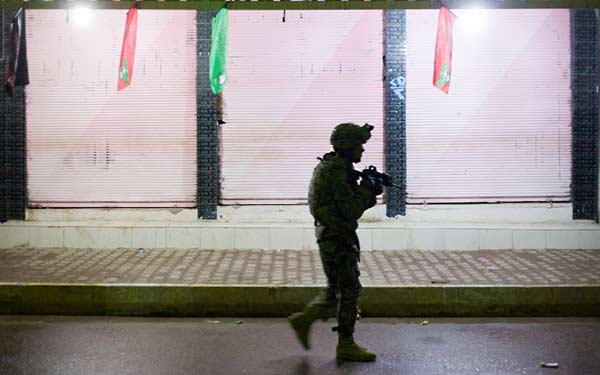
The IED explosion happened in the morning, 1200yards from where I was walking to get a breakfast falafel at the police station. The boom was deep, not like fireworks from the sky, but a percussion from the ground, the earth wounded for a moment, insulted. I could not control an ‘oof’ as air was punched lightly out of me. Gunfire followed, the Iraqi Police firing into the air to disperse crowds and let them know they’re there — security?
Iraqi police and American MP’s had been up all night in preparation for a Shiite Pilgrimage called Ashura. Boom. Not allowed to be practiced under Saddam, the devout whip and cut themselves in observance, faces covered in blood, white shirts crimson with the owner’s blood, of the very devout, when things go right.
The explosion was near a Mosque on the route. I had walked that route at 3am with soldiers, either we missed it or it was planted after us, I like to think it was planted after we passed, can take only 1.3min to place, Iraqi police are known to sleep at their posts. Some of the devout are now dead in a deep disruption of earth, air and peace; many are covered in blood, not by their own hands, maybe not their own blood.
The devout bleed, the devout weep.
Back at the station, wearing my armor because I still want to get breakfast, Iraqi Police, knowing I’m there to take photos, “Want photo?” one asks, making a contorted dead face, “go hospital, many photo,” he is smiling, I don’t know why.
I’m sorry, I wish I had seen the bomb on our patrol, it was near a bridge, it was dark, I remember the bridge, I feared walking under it, bridges are where bad things happen, I didn’t look for bombs, it’s not my job, I don’t know what to look for, I am not trained, I was told to stay near walls, or in the middle of the patrol of soldiers, if the patrol leader holds his hand down in a certain way we were to get on one knee, I did not look for things out of place, I concentrated on not stepping in sewage water seeping from canals, I did not use a flashlight because I didn’t want to be seen by a sniper, instead I fiddled with my recorder, I increased the ISO of my camera, I did not look at the side of the road unless an angry stray dog was threatening, the soldier near me aiming his pistol at it just in case, they protect me, I did not see a bomb, I wish I did, I’m sorry, I’m here to observe but It was dark, I did not see, it may not have been there yet.
Christmas wishes from soldiers at U.S. Army Contingency Operating Base Speicher, Northern Iraq: Sgt. First Class Siatuu Quarterman, Sgt. First Class Claudia Bullard, Staff Sgt. Brian Allen, Specialist Nico Kane, Staff Sgt. Robert Lacome, and Simon Welte.
Aired 2009-12-24 on APM Marketplace; by producer Jake Warga, “Iraq: Soldiers’ Wishes” (1:42 mp3):
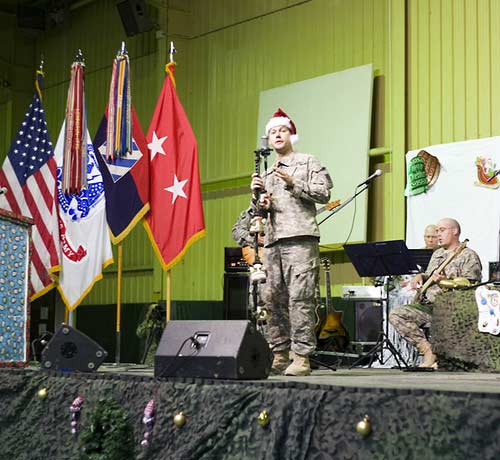
Sgt. First Class Jodie Manford and the 3rd Infantry Division Band spread some holiday cheer via Chrismas songs, at the U.S. Army Contingency Operating Base Speicher, Northern Iraq.
Aired 2009-12-21 on PRI The World; by producer Jake Warga, “Iraq: Singing Soldier” (2:04 mp3):
Embedded with the Chaplin… yes, sounds strange to me too.
Here he is walking to service:
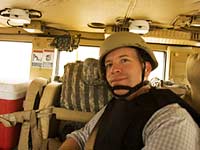
Two schools: Christmas on the battlefield is best ignored, or fully embraced. Our convoy of MRAPs (Mine Resistant something something’s) and HMMWVs (HighMobility Multipurpose Wheeled Vehicle… aka: Humvees) drove from base to a joint forces outpost to deliver cheer — in this case a large plasma TV for Xbox tournaments. They were glad to see the Chaplin, he came with some promised bibles, they were very happy to see the TV (Tele-vision). Two frozen turkeys started thawing as well.
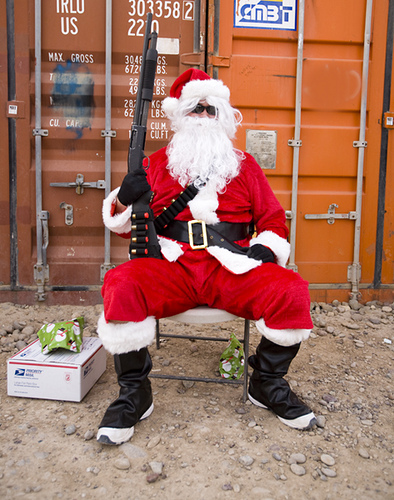
Wandering around base I found Santa with a shotgun defending a stash of presents sent from the states by organizations and school children who would pee just seeing this Clause. Everyone was peeing themselves laughing, I recorded him: “Merry Christmas Mother F…” He does the gun loading move for the F part. I too get stockings in the spirit of the season for there were far more stockings than troops in this section.
I miss my Grandmother, inside is what she used to get me for Christmas — everything from the pharmacy:
Road and Track magazine
Deodorant
Tin of tobacco chew
Toothbrushes and paste
Sox
Handy wipes
Detergent
Q-tips
Oh, how silly I thought. Then I picked-out the toothpaste because I was low. Then the tissues because the desert/pollution sinuses I’ve gone through so many packs already. I keep a pack of handy wipes because they’re so handy and I’m running out, the dust, oh the dust. Sox sure I’m on my feet most of the day. Lastly, I started reading an article in Road and Track about GPS navigators.
A card was at the bottom, drawn by a child, for a class project, tree penned in green, time was spent, an American flag, not colored within the lines, and a penciled letter cut and glued:
Thank You so much for serving for our country and keeping us safe. I appreciate you trying to keep everyone in America safe. Have a great Christmas. I hope you get to have a little celebration of Christmas. May we have peace on earth. From: Julia, Franklyn Elementary.
No, seriously
The other stocking of gifts I gave to an interpreter smoking outside his CHU (Container Housing Unit), just down from mine. In the spirit of giving.
“Merry Christ…” I started. “A gift” I ended. He was very happy, and so was I in the spirit of giving.
Woke up in a palace today, stared-up at huge golden chandeliers dangling from the ornate ceiling of a former palace. Mahmoon Palace or “Birthday” palace. Where Saddam’s birthday was celebrated. Less glamorous at eye-level: I lay on a dusty cot, and my neighbor in a public storage-like plywood cubicles was playing Alvin and the chipmunks Christmas. They had little warning that a reporter was coming, they were told I wanted to cover Christmas stories, I came to the Middle East to avoid it.
The famous balcony, where Saddam fired off his famous gun.
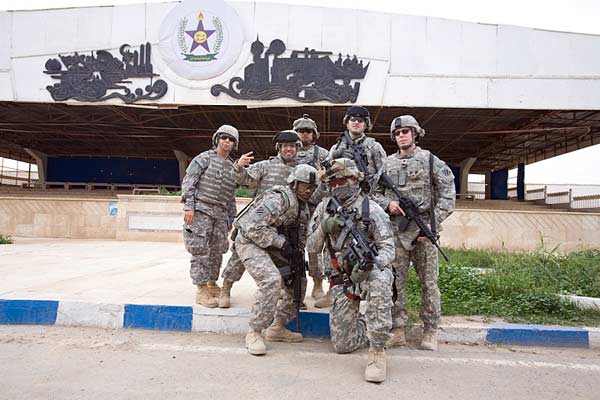
Troops posing outside the Palace bandstand
It’s kind of sad the disrepair here.
Large plasma TV, Xbox, PS2’s, internet terminals. Soldiers play war games, up to 4 at a time, executing their training in play. Boredom is the greatest threat here, complacency is its danger. They are very good warriors, I rarely see their screens turn red with electronic blood.
“People of Wal-Mart” website went viral in the banquet room, for that’s what this huge room was, ultimate of class and luxury, marble marble everywhere. We gathered around to look at the website: “Aw, no way!”s and “Shit, is that a dude? Fuck that!”s and “Hell no!”s, everywhere. One of those came from my lips.
Nice soldier, Joe, likes metal, from California as well. He tells others “man, we grew-up an hour from each other” but light-years. He turned 21 the day before, old enough at last but not a drop to drink. I asked him why he joined: “The health benefits, my wife is on expensive anti-seizure meds.” He loves to talk about weapons–a grenade launcher, I forget the caliber, is his favorite. Weapons weapons everywhere. Not guns, weapons. He pretended to defend me as I got a haircut. Has a 6mo old daughter, took her to Disneyland recently. Old enough.
It takes a while for soldiers to open-up to reporters. I know what they’ve been told about us, but I’m not supposed to know, so I won’t say. I needed an opening. A horror movie was thrown on late last night, a break from the gory video games to just gore. The man who I call dad in my life, his name came up, director of photography “hey, that’s my dad” I said. One mouth fell open. I said I too used to work on horror movies, more looks my way. I was in at last.
It’s “hum-vee” not “hummer”. The former is driven, the latter drives.
Comforts of home. It’s not REAL mountain-dew, it’s called “squiggly-dew” because it’s in Arabic and, the greatest complaint: it uses real sugar cane instead of high-fructose corn syrup. The Sergeant showed me the stash of a yummy caned coffee drink for us old-timers. Pallets of bottled water water everywhere. Tap water comes from the Tigris, never open your mouth while showering, don’t taste history.
[“Iraq: Christmas 2009“: observations, images and sounds from Iraq, Christmas 2009, a series of posts by Jake Warga.]
Oh the things I’ve seen.
I shall never complain about long lay-overs again.
I have flown in a C-17 transport.
I shall never complain again of uncomfortable seats again.
I have ridden in the belly of a Stryker.
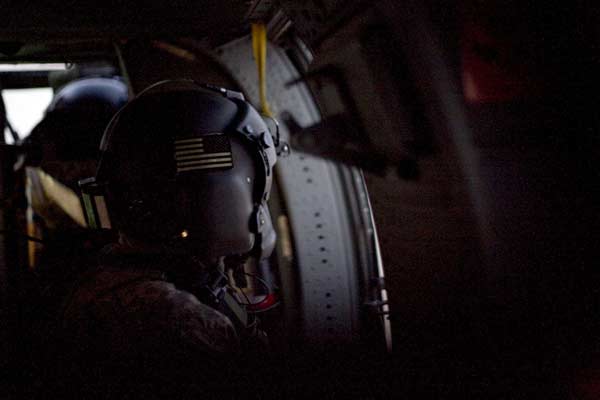
What do you get when you stick a public radio guy with a Fox TV crew in the back of a Black Hawk for a multiple re-fuel hop up to Northern Iraq?
A bumpy ride.
I saw an injured dove in Baghdad trying to be nursed back to health on a blast wall away from cats. It had a saucer of water and feed, don’t know who put it there. I saw a dead dove come evening.
I got a serious cold sleeping in a 20-man tent during a thunder storm, closest I’ve come to being attacked.
I have yet to meet someone who wants to be here. I have met some wonderful people.
For lunch the other day I had crab legs, the desert bar is endless, burger king is everywhere. Where else in Arabia can I eat bacon and watch Fox TV on flat screens throughout a mess hall?
Ugandans hired by KBR guard entrances to buildings on bases, the Peruvians have the evening shift. They look at my passport, I don’t think they know what they’re looking for.
A papier-mâché Mount Rushmore and Statue of Liberty are in the DFAC (Dining FACility). Pakistanis do the dishes. You’re not allowed to bring bags into facilities or wear a hat, but you are required to have a weapon. I am unarmed. I know now the difference between an M16 rifle and an M4 Carbine. Both are 5.56 Caliber, I don’t know what that means but I was given a pamphlet.
The military is run by acronyms. I’m staying in an LSA (Life Support Area).
It’s almost encouraged to have a bad hair cut, in this I feel at home.
I go next to JCC in Tikrit with PSD (Joint Coordination Center…Personal Security Detail), I feel important, I may be a fool. I spend Christmas Embedded with the Chaplin…why not. Here’s what soldiers want for Christmas (4:07):
Black hawk gunner
Dust goes to one lung, trash burns go to the other.
Met a soldier young enough to be my daughter, I become a grandfather when she tells me about her 5yo back home. Everyone dresses the same, it’s confusing, uniformity, conformity, camouflaged in green in a land where there is only brown.
With love from the war on terror. Pictures at Flickr.
Virtuoso Voices has compiled interviewing tips from pubradio personalities Bob Edwards, Susan Stamberg, Kurt Andersen, Lisa Mullins, John Diliberto, Lynn Neary and others. It’s all in a 25-page Interviewing 3.0 pdf (296KB).
David Schulman’s (of MITOW) thots on interviewing “feng shui” are revalations. Below are some excerpts from “Interviewing Performing Artists… and Others: A Practical Guide”…
Think of it as a conversation and not an interview. If you do an interview, it will likely SOUND like an interview. How do you talk to a friend over a beer? First you LISTEN—and you react to what you’ve heard. If someone tells me something really interesting, I’ll simply say, “Really?” or “No!” Those are little words of encouragement that signal the speaker to continue—and to expand on previous remarks. If your guest is truly confusing, try “Huh?”
Indulge yourself. Ask the question you’ve always wanted to ask. “What’s that lyric about?”
Don’t be afraid to ask the hard question. They aren’t your friends and you don’t have to worry that they won’t like you or walk out. Although occasionally they do.
Don’t be afraid to ask the obvious question. I got this from listening to Terry Gross, who, besides being a probing interviewer, also knows where the good stories are and isn’t afraid to query into known terrain, because a good story is still a good story, even if it’s been heard before. Chances are, most people still don’t know it. Then find a different angle on that story.
by Jay Kernis 2006-12-19 (Presentation to NPR Stations)
It’s an exciting time to be in public radio — as we all try to figure out how we will become public media.
For more than a year now, under the New Realities banner, the public radio community has been talking about everything from how to use new technology to share stories from the past and present — to creating a new business model to fund public radio — to articulating our mission in a media world that offers so many choices. A new world where the biggest challenge is just getting the attention of the audience.
Here’s one provocative statement from these discussions — a challenge — that really got me thinking:
“NPR has found its distinctive SOUND.
It is now time for NPR to find its true voice.”
–Quote from an NPR reporter (February 2006)
To me, that reporter was saying: it is time for us to discover what we truly want to become.
Because if we fail to do so, audiences will go elsewhere. If we fail to do so, we will be prey to the others who will define us. The others who call us “liberal” or “effete” or “boring.”
The statement by the reporter differentiates between our sound and our voice. I’m going to talk about both for a few moments.
To help us find our true voice, I asked NPR News to make a few what I called “tweaks” — SIX OF THEM actually — most of them involving the issues we’ve been discussing for years. Decades, actually.
First, I told them that when people tune to an NPR program, I want them to hear reports and interviews and essays that inform them, of course, and that ask them to question preconceived notions — but that’s not all.
I want the air to SING. I want programming that carries listeners to new places — intellectually and emotionally; programming that awakens you, that keeps you in your car to hear the ending, and that makes you want to tell a friend about what you heard. That makes you want to tune in again and again. Programming that soars — and sings.
But, the six areas I want us to pay a lot of attention to — right now — are: More…
Listen : John Cage – in love with sound / silence -01
Transcript of the interview with John Cage in the film “Ecoute” (Listen) by Miroslav Sebestik:
[part 1]
When I hear what we call music, it seems to me that someone is talking, and talking about his feelings, or about his ideas of relationships. But when I hear traffic, the sound of traffic, here on 6th avenue for instance, I don’t have the feeling that anyone is talking. I have the feeling that sound is acting. And I love the activity of sound. What it does is it gets louder and quieter, and it gets higher and lower, and it gets longer and shorter. It does all those things.
I am completely satisfied with that. I don’t need sound to talk to me. We don’t see much difference between time and space. We don’t know where one begins and the other stops. So that most of the arts we think of as being in time, and most of the arts we think of being in space. More…
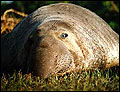 Elephant seal, California’s Monterey Bay National Marine Sanctuary.
 Humpback whale near Maui, Hawaii.
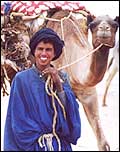 Mali camel herder “On the Edge, Timbuktu.”
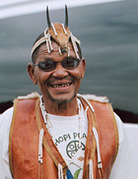 Roy Sesana, Bushman elder (Kalahari Desert, Botswana), on a hike in the Santa Monica Mountains, “From the Kalahari to Malibu.”
 CJC, EP of Radio Expeditions, on the Rio Tiputini (photo: Flawn Williams).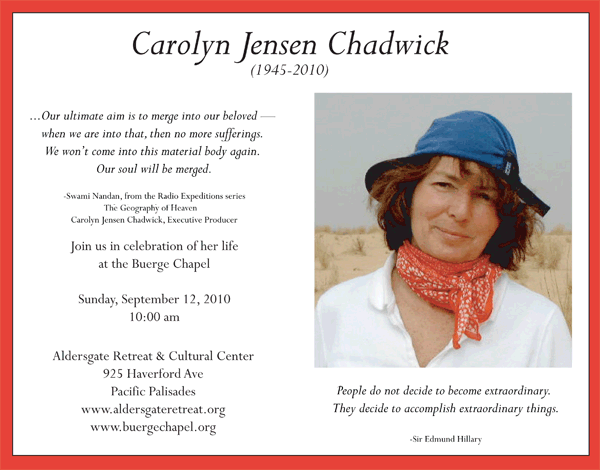
 The publshers of


 I read these things so you don’t have to: a 30-page essay, “
 [Jake’s out of Iraq, and back in Dubai…]

 Christmas wishes from soldiers at U.S. Army Contingency Operating Base Speicher, Northern Iraq: Sgt. First Class Siatuu Quarterman, Sgt. First Class Claudia Bullard, Staff Sgt. Brian Allen, Specialist Nico Kane, Staff Sgt. Robert Lacome, and Simon Welte.
 [“
[“

 [“
[“