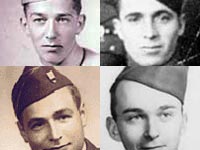
Produced for the Vermont Folklife Center: In December 1944 the Allies were closing in on Germany. Hitler had a desperate plan to save the Third Reich, a massive assault he believed would so demoralize that the Allies, they would seek a separate peace, leaving only the Russian army on the eastern front. On December 16 the Germans unleashed an offensive that would become the most brutal battle of the European war: the Battle of the Bulge. Nineteen thousand Americans were killed, about the same number were taken prisoner. We hear from four Americans soldiers about their time in — before, during and after — a German POW camp: Cliff Austin, Harrison Burney, Bill Busier, and Robert Norton.
VFC Radio published a transcript and a CD of “Prisoners of War.” Harrison Burney wrote “From The Bowels of Hell, a soldier’s memoir of World War II, 1944-1945 (143k PDF). Music: “Reitba” and “Concerto No. 3 for Double-Bass and Piano,” composed and performed by cellist Francois Rabbath; “String Quartet in C Major”, the second movement in the “Emperor” by Franz Joseph Haydn, performed by the Concord String Quartet; and “St James Infirmary” from pianist Allen Toussaint’s The Bright Mississippi.
Erica was a private investigator; now she’s a radio producer. The skills overlap: you ask questions, try to figure what happened, and make a report. (None of the interviewees were clients when she recorded them.) Produced by Larry Massett.
A good neighbor goes bad in the producer’s DC block. Dozens of rats are infesting her yard and attacking other houses. Produced for This American Life, “Neighbors,” and part of Katie’s Neighborhood Stories series. End music: Music: “Cheval Noir” Fug, Ready For Us..
“I can break the law because… I am the law.” Sleepless in Tbilisi. A twenty-four hour tour, from Turkish baths to Batumi beaches, through the country of Georgia, in Southwest Asia. High-speed sight-seeing, driven by the accidental tourguide: “a ‘detective,’ or ‘special police,’ or ‘security force.’ It’s not clear. Sometimes he even says ‘KGB,’ though that no longer exists… does it?” Music: “Dachrilis Simgera (Song for Wounded)” Tbilisi Vocal Ensemble, Georgian Folk and Sacred Songs (2002). (Annotated transcript.)
Beatrice is a white toy poodle, a neighbor, and “the most evil entity, force, energy known to man. Death to humans is a mere plop of a pebble in the ocean that is the evil that you are Beatrice. Evil Beatrice the white poodle.”
From Sonic Scenery, an exhibit I worked on at the natural history museum in Los Angeles a couple years ago. Composers were invited to record music specifically to be heard in wings of the museum. The visitor wears a headset, which plays the compositions when triggered by remote signals in the galleries. Experimental duo Matmos took it all the way by making audio environments for each of the seventeen dioramas in the North American Mammals hall. The timechart (above) was intended to cue the visitor to move from one window to the next, but you can read along for a similar effect.
Artist statement:
In general, our work starts by taking an object, making sounds with that object, and working outward from those sounds in a free-associative manner, without a preconceived result or specifically targeted genre in mind.
In this case, we have had to reverse this process and have tried to think about the precise specifics of the North American Mammals hall and work to gather sounds that will evoke both the natural locale and the specific behaviors of the animals in the room. We decided to anchor our piece around the sounds of animals eating, breathing, and sniffing their environment, and to locate these noises of animal life against a backdrop of plateaulike drones generated with musical instruments associated with “Americana”: pedal steel, acoustic guitar, banjo, harmonica, and autoharp. Feeding peanut butter to a friend’s dog, we built up a basic library of mammalian lip-smacking, huffing, barking, whining, sniffling, and breathing noises, and combined this with a percussive battery of antler noises made by smacking deer antlers against each other and some softer rustling textures harvested by stroking and rubbing the pelt of a wolf.
The work is divided into miniature ‘cells,’ which stand in for the seventeen distinct dioramas/environments and animal species represented in the room, and this is split down the middle by a central section that corresponds to the large bison display at the far end of the room. Our work is intended to be a sound map of a walk through this room and is paced to coincide with a five-to-seven-minute counterclockwise walk through its contents
–Matmos
“17 Species of North American Mammals” (2:22 excerpt) Matmos
LA’s The Natural History Museum commissioned original music compositions to accompany their 2006 exhibit Sonic Scenery: Music for Collections. Matmos’ music used the vocal sounds of North American mammals.
One of America’s oldest roadside attractions is the Linesville Spillway in northwest Pennsylvania. Tourists toss bread; carp amass at the spillway’s edges: The fish are so thick that mallard ducks hop, skip and jump on the fish’s backs to compete for a slice of bread. Original music by Tim Fite, part of LHP’s song/story series.
Writer (Amazon), hunter, angler, outdoorsman, Norman Strung demonstrates the shrill sound and thrill found in calling for elk. (Miss ya, Norm: “Labradors [are] lousy watchdogs. They usually bark when there is a stranger about, but it is an expression of unmitigated joy at the chance to meet somebody new, not a warning.” –Norman Strung)
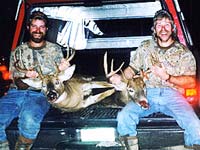
Father Rupe LaRock and son Joe provide a hunter’s perspective of the annual deer breeding cycle. “You can just smell the heat and smell the rut right in the air.” Another of the Deer Stories , produced with Gregory Sharrow at the Vermont Folk Life Center.
Guns, guitars, guts, and wild game. Hunting wildlife and the wild life in the mountains of Payette National Forest. From the Chadwick’s Conservation Sound series. Audio by Micheal Scweppe.
Tolstoy wrote, “Happy families are all alike; every unhappy family is unhappy in its own way.” But sometimes it’s hard to tell who is and isn’t happy:
“Crossdressing Family Man” (12:33) Eric Winick of Yarn Audio Works
After decades together, the Nadeaus find their husband/father has a secret. This story, told by family friend, come to us from Transom, which has a longer version, with photos and family history. [Music: Bach Six Cello Suites performed on viola performed by Patricia McCarty (Ashmont Music), Stravinsky “”Apollo” Three Greek Ballets performed by London Symphony Orchestra (Naxos).]
Steve Fugate roams the roads of America, walking thousands of miles with a sign stuck over his middle-aged head that reads “Love Life” — because of what happened to his son; recorded by Mark Baldwin, produced by ). Follow Steve’s writing and walking at Trail Therapy. [Music: Stravinsky “Agon” Three Greek Ballets performed by London Symphony Orchestra (Naxos), Bach Six Cello Suites performed on viola performed by Patricia McCarty (Ashmont Music), Dolly Parton “Silver Dagger” The Grass Is Blue.]
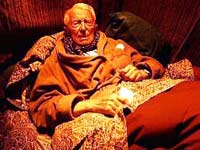
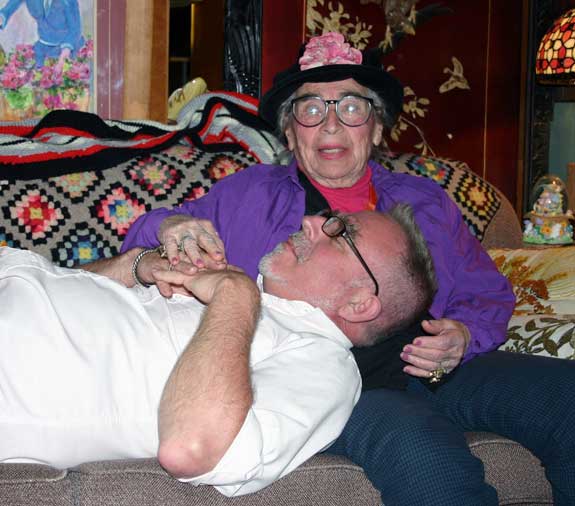
We follow an evolution of relationships revealed in conversations between Greg Sharrow, his mother Marjorie, and Greg’s husband Bob Hooker, as Marjorie’s dementia progresses. Produced with the Vermont Folklife Center. Transom has the original longer version, with photos. [Music: Karinne Keithley.]
A Vermont family changes as their mother’s dementia progresses. What happens to love when there is no memory? An evolution of relationships reveal themselves in these conversation between Gregory Sharrow, his mother Marjorie, and Greg’s husband Bob Hooker.
HV and Transom just finished collaborating on getting an edited version of Eric Winick’s “How Are You Who You Are?” on NPR ATC. Our next co-project was just posted: “Transom Show: After The Forgetting” by Erica Heilman (who has a resume item you don’t see often: “an independent radio producer and private investigator”).
Th story documents a Vermont family’s changes as their mother’s dementia progresses. What happens to love when there is no memory? An evolution of relationships reveal themselves in these conversations between Gregory Sharrow, his mother Marjorie, and Greg’s husband Bob Hooker. (Produced for The Vermont Folklife Center with music by Karinne Keithley.)
 Hearing Voices from NPR®




 .
.

 by Paul Kiernan (
 ) by Erica Heilman (
 .
.



 Follow Steve’s writing and walking at

 HV and Transom just finished collaborating on getting an edited version of Eric Winick’s “